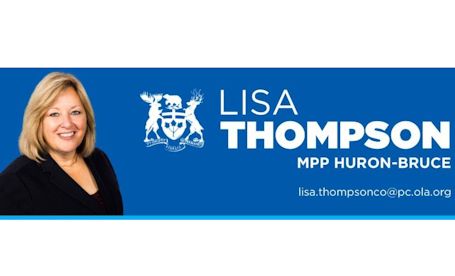
Huron-Bruce MPP says budget lays groundwork for Ontario's recovery
Thursday, the provincial government released its 2020 budget, titled “Ontario's Action Plan: Protect, Support, Recover,” and Huron-Bruce MPP Lisa Thompson says the document is “the next phase of a comprehensive action plan to respond to the serious health and economic impacts of COVID-19 (Coronavirus).”
The budget sets out a total of $45-billion in support over three years to make available the necessary health resources to continue protecting people, deliver critical programs and tax measures to support individuals, families and job creators impacted by the virus, and lay the groundwork for a robust long-term economic recovery for the province.
Thompson said the budget is “a very thorough and vital plan for going forward. We are all facing serious challenges today due to the pandemic, but we are prepared to meet those challenges together.”
The budget is separated into three sections – Protect, Support, and Recover.
Protect
Ontario's COVID-19 health response is now a projected $15.2-billion. The government is making available $6-billion over the next three years to ensure the province can remain responsive to evolving needs in the fight against the pandemic.
Thompson said the 2020-21 spending includes “the most comprehensive and robust plan in the country” to respond to the second wave of COVID-19. It also includes additional funding to support hospital beds, address the surgical backlog, and purchase additional influenza vaccines.
The province is investing more than $18-billion in capital grants over 10 years to build new and expanded hospital infrastructure and address urgent upgrades, including repairs and maintenance to help modernize hospitals across Ontario.
To protect loved ones in long-term care from a second wave of COVID-19, and to address long-standing issues in the system, Ontario is providing more than $500-million to enable necessary renovations and measures to improve infection prevention and control, allow for the purchase of more Personal Protective Equipment (PPE), and to build a strong health care workforce.
The province plans to increase the average daily direct care of long-term care residents from a nurse or Personal Support Worker (PSW), to four hours per day. This additional care will be phased in over the next four years and will make Ontario the leader among Canadian provinces.
Support
The government is now delivering an estimated $13.5-billion in total support for people and job creators as part of its action plan. This additional relief will ensure families, seniors, businesses and workers are supported through the second wave of COVID-19 and beyond.
To help offset some of the additional costs of COVID-19, parents will once again receive $200 per child under age 12, and $250 for children and youth with special needs age 21 and under. This means a family with three young children, one of whom has special needs, would receive $1,300 in 2020.
The government is taking significant steps to protect seniors and allow them to stay in their homes longer. The province is proposing a new Seniors' Home Safety Tax Credit for the 2021 taxation year, which would provide a 25-per-cent credit on eligible renovations of up to $10,000. Seniors would be eligible regardless of their incomes and whether they owe income tax for 2021. Family members who have a senior living with them would also be eligible.
Recover
While COVID-19 will impact Ontario and the entire world for the foreseeable future, the budget begins to build the foundation for a strong economic recovery fuelled by growth. Among the major initiatives proposed by the government, are a reduction of job-killing electricity prices, reducing taxes on jobs, connecting unserved and under-served communities with an historic investment in broadband infrastructure, and providing workers with skills training — including those impacted by the pandemic, such as tourism and hospitality workers — to help them connect to jobs needing high-demand skills.
The government is also acting immediately to reduce taxes for job creators and level the playing field by lowering high provincial business property tax rates to a rate of 0.88 per cent for more than 200,000 properties — or 94 per cent of all business properties in the province. This would create $450-million in annual savings in 2021, representing a 30-per-cent reduction for many employers.
Ontario is responding to requests from local governments by proposing to provide municipalities with the ability to cut property tax for small businesses, and a provincial commitment to consider matching these reductions. This would provide small businesses as much as $385-million in total municipal and provincial property tax relief by 2022-23, depending on municipal adoption.
The province is also ending a tax on jobs for an additional 30,000 employers by proposing to make permanent the Employer Health Tax (EHT) exemption increase to $1-million from $490,000. This would save private-sector employers $360-million in 2021-22, which could be reinvested in jobs and growth. About 90 per cent of employers would pay no EHT with this additional relief.
The budget outlines a plan to reduce the burden on employers of Ontario's high-cost contracts with non-hydro renewable energy producers, which will be wound down once and for all. Beginning Jan. 1, 2021, a portion of the cost of these contracts, entered under the previous government, will be funded by the province, not the ratepayers. This electricity cost relief would free up money that could be better spent creating jobs.
Medium-sized and larger industrial and commercial employers would save about 14 and 16 per cent, respectively, on average, on their bills starting in 2021. This means Ontario will go from having some of the least-competitive electricity prices to prices that are more competitive than the average in the United States.
“Because of the pandemic, this budget is much more important than budgets in previous years,” said Thompson. “That's why we have taken major steps to ensure that we will protect and support our citizens and we have a solid plan to help our economy recover.”
The government is projecting a deficit of $38.5-billion for 2020-21, which is unchanged from the deficit forecast at the time of the “2020-21 First Quarter Finances” and reflects urgent spending necessary for the fight against COVID-19.
Over the medium-term, the government is forecasting steadily-declining deficits of $33.1-billion in 2021-22 and $28.2-billion in 2022-23. Acknowledging the continued uncertainty of the global pandemic, the government plans to table a multi-year plan, including a path to balance in the “2021 Budget,” by March 31, 2021.
Budget by the numbers
- $5-million in new funding to supplement agricultural and horticultural societies annual grants this fiscal year, helping to offset revenue loss and the impacts from having to cancel agricultural exhibitions and fairs due to COVID-19.
- $25.5-million over three years toward the Agri-Food Prevention and Control Innovation Program
- $680-million over the next four years in broadband infrastructure (combined with its prior commitments, increases Ontario's investment to an historic nearly $1-billion)
- A new Seniors' Home Safety Tax Credit for the 2021 taxation year, which would provide a 25-per-cent credit on eligible renovations of up to $10,000
- An additional $6-billion over the next three years to fight COVID-19
- An additional $380-million to parents through another round of payments: $200 per child under age 12, and $250 for children and youth with special needs age 21 and under
- $2.8-billion to support the province's “Fall Preparedness Plan for Health, Long-Term Care and Education”
- $572-million in Ontario's hospitals to support additional costs of COVID-19, including testing, assessment centres, laboratory and medical equipment, and PPE
- $500-million for long-term care to enable necessary renovations and measures to improve infection prevention and control, allow for the purchase of more PPE
- $1.8-billion in the Support for People and Jobs Fund over the next two years
- $4.8-billion in initiatives to support jobs
 Written By
No bio for this author.



Related Stories
No related stories.