Huron OPP report drug-impaired driver; and urge motorists to beware of deer
IMPAIRED BY DRUG CHARGE LAID
(ASHFIELD-COLBORNE-WAWANOSH, ON) - The
Huron County OPP has charged a Clinton resident with Impaired Operation and Dangerous Operation, following a traffic stop that took place in early November.
Nov. 5, at approximately 7:30 p.m., Huron OPP officers received multiple calls about a pick-up truck that was travelling eastbound on Amberley Road in a very erratic manner.
An officer was able to intercept the suspect vehicle as it entered Wingham and a traffic stop was initiated on John Street. Upon stopping the vehicle and speaking with the driver, the investigating officer noted the driver was displaying signs of impairment by a drug. As such, an arrest was made and the driver was searched. Upon searching the driver, the investigating officer found the driver to be in possession of a small quantity of suspected cocaine.
The driver was transported to the Clinton OPP detachment where an evaluation was conducted by a Drug Recognition Evaluator (DRE). Upon completion of the examination, the DRE deemed the driver to be impaired by a drug.
Alexander DUNN, 25, of Clinton has been charged with Impaired Operation, Dangerous Operation and Possession of a Schedule I Substance - Cocaine. The accused was released from custody with a court date scheduled for Dec. 21, at the Ontario Court of Justice – Goderich.
*THESE CHARGES HAVE YET TO BE PROVEN IN COURT*
A REMINDER TO WATCH OUT FOR DEER
(HURON COUNTY, ON) - The
Huron County OPP reminds motorists to continue to watch out for deer on roadways when travelling.
Based on OPP collision data, November and December are two months when drivers are most likely to encounter deer on the roadways. If you drive on rural roads in Huron County, it is almost a certainty that you will encounter deer on the roadway at some point.
Over the past week Huron County OPP officers responded to a total of 28 collisions in the county. Exactly
50 per cent were collisions involving animals, 13 with deer and one with a coyote.
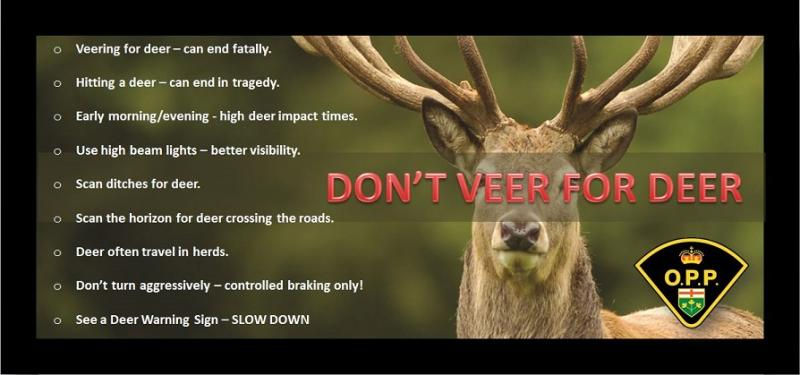
Here are some tips for drivers to avoid collisions with wildlife:
- Pay attention to deer-crossing warning signs and drive with extra caution when travelling through areas known to have large deer populations. Remember, if you see one deer there is a good chance others will be nearby.
- Be especially attentive from sunset to midnight and during the hours shortly before and after sunrise. These are the highest risk times for collisions with deer.
- When driving at night always use your high beams when there is no oncoming traffic and continually scan the roadway, shoulders and ditches for animals.
- Always wear your seatbelt - most people injured in wildlife collisions were not wearing a seatbelt.
- If you encounter a deer or large animal on the roadway, slow down and brake firmly if a collision is unavoidable. Avoid swerving for a deer. Many serious crashes occur when drivers swerve to avoid an animal, only to hit another vehicle or lose control of their vehicle.
If a collision does occur, stay calm and pull your vehicle off to the side of the roadway. Activate your emergency four-way flashers and if you have to get out of your vehicle, be aware of your surroundings.
Call 9-1-1 if you or your passengers are injured. If nobody is injured and the dollar value of the damage exceeds $2,000, you are required to report the collision to police as soon as possible. Please use the non-emergent line to contact police by calling 1-888-310-1122.
Remember, when you see the deer-warning signs, slow down and take caution - the signs are there for a reason.
 Written By
No bio for this author.



Related Stories
No related stories.