Ask the Pharmacist
Q: At work today, I heard some people celebrating that when Ontario sort of re-opens Feb. 16, our region will be a yellow zone and not orange like so many of the areas around us. Then I heard others lamenting that we were not deemed COVID-19-free enough to attain a green designation like Kingston did. What exactly do these colours mean and how does one move from one to the other?
A: We do hear a lot about the different colour zones in all the forms of media in this province. It is important to note that every province has its own system when it comes to regulating activities so what we are going to talk about is unique to Ontario.
Other than the basics (i.e. red is bad), most of us do not really know that much about what exactly each of these colours means.
The principles that stand behind this system make sense, given the health crisis we are in. Foremost among these is responsibility. It is perhaps any government’s primary duty to keep its citizens safe, in particular, those most vulnerable which includes the elderly.
The government’s website also outlines that it has a responsibility to keep both child-care centres and schools open, if safe to do so. This makes sense both in terms of allowing our essential workers, and the rest of the economy (depending on the zone) to do their jobs, as well as protect our children’s futures along with ours, as prolonged disruptions to education may have long-term negative consequences.
Other principles include that all decisions will be evidence-based (let’s hope that’s the case, although political futures can get in the way of sound decision-making at times), proactive, graduated and responsive.
Lastly, the plans and responsibilities for both individuals and businesses should be made abundantly clear to them, with respect to the level they are at. Whether that has been implemented as well as it should have been, should be questioned, as there seems to be lots of confusion when it comes to the differences between the zones.
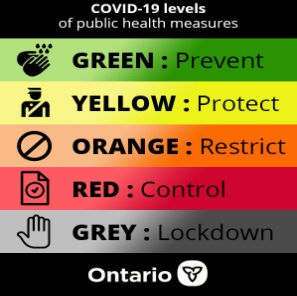
In the Ontario government’s
COVID-19 (Coronavirus) Response Framework (right), there are five zones, and each one has been given both a colour and associated name.
​The one with the least restrictions is the “Green” zone, also known by the moniker, “Prevent.” In this zone, the weekly incidence of COVID-19 is less than 10 per 100,000 people, and testing results in a positive test less than 0.5 per cent of the time. The effective reproductive rate (Rt) of the virus is a measure of the average number of other infections that one already infected person will cause in the general population - a value greater than one means the number of cases is increasing daily.
In the Prevent zone, the Rt is judged to be less than one and there is lots of room in our hospitals and Intensive Care Units (ICUs) to accommodate those who get most sick.
Maximum capacity for social gatherings tops out at 10 people indoors and 25 outdoors unless it’s a public organized event in which case, the numbers are 50 and 100, respectively. Restaurants can be open as long as they can maintain a two-metre distance between tables, and fitness centres can have up to 50 people at a time. Retail locations are allowed to get by with passive screening only.
Next, is “Yellow” or “Protect” which is where the Grey Bruce Health Unit current sits. In this zone, the weekly incidence of COVID-19 is between 10-24.9 cases per 100,000 people and the positive test rate is somewhere between 0.5-1.2 per cent. Once again, the hospitals have plenty of capacity left and the number of community-transmitted cases is either stable or increasing but the effective reproduction number is approximately one.
As far as life on the ground goes, there are a few more restrictions in place, such as liquor can be sold/served only until 11 p.m., face coverings are required at recreation facilities (unless exercising), and some establishments are required to keep contact information of their patrons although most retail stores still require only passive screening measures.
The third zone is “Orange” or “Restrict.” Here, the weekly incidence rate of new cases is between 25-39.9/100,000, and the odds that a test will be positive increases to between 1.3-2.4 per cent of the time. The Rt is approximately one to 1.1, and likely there has been an increasing number of large outbreaks within the zone. There is still excess capacity in the hospital but occupancy may be increasing.
At this level, the capacity at events is reduced to a maximum of 50 people per facility, hours for businesses are limited, and personal care services that require the removal of a face mask are prohibited. There are enhanced screening measures at various businesses and some may have their capacity limited further.
The “Red” or “Control” zone is the level at which most of the large cities we know and visit (London, Waterloo, Guelph) now sit. Pertinent numbers here are a weekly incidence of 40 or more cases per 100,000 people, and a positive test rate of 2.5 per cent or more. The Rt has now climbed to at least 1.2 and, most critically, the hospitals and ICUs are at risk of being overwhelmed.
Some of the new restrictions that occur at this level include reducing attendees at any social gathering to a maximum of five people indoors and 25 outdoors. Restaurants and gyms cannot have more than 10 patrons at a time (which makes for a very challenging business model in every respect), and cinemas and performing arts spaces are closed. “Essential” businesses, such as supermarkets and pharmacies, can operate only at 75-per-cent capacity, and all other retailers are reduced to 50 per cent of their usual number of patrons, which must be posted outside of the establishment.
The final zone is “Grey” or “Lockdown” which has as its sole occupant, the Niagara region. Here, the raw numbers are similar to the Red zone but the incidence of weekly cases and positive tests continues to increase, and there are increasing outbreaks among vulnerable populations, such as at long-term care facilities. Hospitals remain at risk of being overwhelmed as does public health’s ability to perform contact tracing.
Restrictions involved with this designation include a prohibition on all indoor social gatherings, dining at restaurants (regardless of whether it is indoors or outdoors), all personal care services (i.e. hair salons), and closing indoor and outdoor sports and fitness facilities. Outdoor public events are capped at 10 people, and pharmacy and grocery retailers are reduced to 50 per cent of their stated capacity, with other retailers reduced to 25 per cent. Mask-wearing and physical-distancing are mandatory (with limited exceptions).
Toronto and the surrounding area, as well as the North Bay/Parry Sound district, will remain in the “emergency stay-at-home order” and are, therefore, considered to be outside the colour/zone system. Only those jurisdictions that have the emergency order lifted are able to go to the colour/zone system.
So, just what are we allowed to do in the restricted zones? Apparently, Netflix viewing is allowed but perhaps you have exhausted your choices with the binge-watching over the past few months and are now looking at other streaming services.
It’s great that our region is now yellow. It will allow us to enjoy ourselves and possibly resume activities that were curtailed - and we are all overdue for that! But let’s not mess this up.
The new variants are here to stay and they are more contagious. Let’s enjoy our newfound freedom without forgoing the smart decisions we have made as a population that have allowed us to “achieve” this level.
For more information about this or any other health-related questions, contact the pharmacists at Gordon Pharmasave, Your Health and Wellness Destination. Also check the website at www.gordon-pharmasave.com/ and the Facebook page at www.facebook
 Written By
No bio for this author.



Related Stories
No related stories.