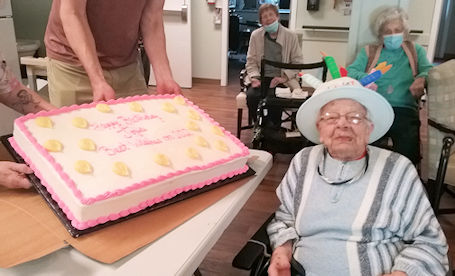
Joyce Van Dam of Tiverton Park Manor celebrates her 102nd birthday
Joyce Van Dam of Tiverton Park Manor celebrated her 102nd birthday last week. The following life story was written by her, with some help from George Potter.
My name is Joyce Van Dam to everyone nowadays, but I was born Sarah Josina Mulder, March 8, 1919, in the City of Zaandam in the Netherlands.
I was the third child in a family of seven, four girls and three boys. As I write this, in my 101st year, I am sad to say that I am the only one left.
When I was born, things were quite primitive. We didn’t have a flush toilet, only an outhouse on the edge of our property. Once each week, some men in a row boat came up the little stream (nothing more than a ditch) to clean out the outhouse. They would pick up the two used bins and replace them with clean ones.
It was not until I was four years old that we got a flush toilet installed under the stairway in the house. I remember this with quite a little excitement when flushing the toilet by pulling on the chain.
The milk was delivered every day. It was held in a big container standing on a three-wheeled cart. You came to the cart with a container and said how much you wanted and paid the man.
The vegetables, etc., came the same way only in a bigger cart that came down the street and you went to the cart and sorted out what you wanted. Fish were sold the same way. We had a woman who stayed on the street. She had a bell and a very loud, sharp voice; we called her the “fish wife.”
Streetlight bulbs were lit each evening by two men with long sticks. When the streetlights were lit, that was the signal for children, who were playing in the street after school, that it was time to go home.
Clothes were washed by hand on a scrub board in a simple wooden tub. Electric washing machines came later.
There was no Kindergarten then. You started to school when you were six years old, and went to the school for six years, or seven years if you were planning to go further.
Our family went to a Christian school. My great-grandfather (Opa) was one of the people who started the Christian school in the Netherlands; I believe that was in the 1850s. He was the principal of a public school before he started the Christian school.
Since this was a Christian school, the government did not support it, and my great-grandfather lost his salary and depended on the parents of the children who attended the school to give him some money.
At that time, only boys went to high school and university. I went to a girls’ school, learning cooking and sewing, etc. My older sister had been there too and returned home to help our mother when she was finished. When I finished, I also returned to help my mother.
But after I had finished my schooling, I wanted a job, a chance to be somewhat independent. My mother didn’t want to hear of it but father over-ruled, and I was allowed to take a job.
My father was an elder in the church. He spoke with Bill Van Dam’s father who was also an elder and worked in the X-ray department of the hospital. I was given a receptionist’s job in the hospital. My job was to greet the people entering the hospital and to operate the telephone system switchboard. I started at 9 a.m. and worked until 6 p.m., but my job was not finished until I had delivered the mail, usually riding my bicycle.
Bill Van Dam was the second child in a family of nine. He was about three years younger than I was, and his family and my family knew each other as we went to the same church and schools.
Since Bill was a boy, he was allowed to continue on through high school, After high school, he went to school to become a navigational signal man on the shipping vessels. That ended when the Germans invaded.
In 1940, the Germans occupied the Netherlands where we lived. For five years, we suffered under German occupation. Food was scarce and of poor quality. The young men, between the ages of 18 and 24, were forced to work for the German army if they were found. For three years, Bill was in hiding with farmers.
In December, 1944, Bill and I were married. I don’t remember a proposal as such; we were just together and fell in love. Things were tough and food was still scarce so planning a wedding meal was a challenge. Somehow, Bill’s father was able to find a pig to butcher, so roast pork was a treat. But the real treat was a slice of real white bread made from wheat. This was obtained from a local farmer who made his own bread.
On our wedding day, the German troops moved in, so all the young men went into hiding. Bill spent his wedding night in a hiding spot under the floor in the hospital. I spent my wedding night with the in-laws.
I remember clearly the day in May of 1945 when the Canadians liberated our town. Everyone was really excited. I jumped up and hitched a ride on an army truck. Everyone was really happy!
Bill and I lived in Holland until 1954. Our three children were born there – Martin, Bill and Harry. We may have continued to live in Holland except that Bill got some sort of blood-poisoning that just wouldn’t leave. He had boils and open sores that the doctors in Holland didn’t seem to be able to cure. One of the doctors suggested that Bill should move to different country.
In his usual way, Bill started to do research. He studied Canada, Australia and New Zealand, and decided Canada was the place for him. But leaving for a different country with a family, and not a lot of cash, was not an easy task. Bill persuaded his younger brother, Harry, to go to Canada a year ahead of him and sort of scout things out.
Because Harry was single, it was much easier for him to pass the immigration requirements. Harry set out for Canada in 1953.
In May, 1954, Bill left Holland for Canada. He was still afflicted with boils and open sores. He got a ticket on a miserable army vessel and made the trip from Holland to Quebec where he met up with Harry and started to work in Canada.
In order to bring me and the children to Canada, Bill had to prove that he had a job and enough money to support the family. He got a job working on a mink ranch near Toronto. Before he left Holland, he had never seen a mink!
By September, Bill was able to prove he had a job and enough security to bring us to Canada. I remember the boat trip from Holland to Canada as being a crowded and rather unpleasant trip. The three boys and I had to share a compartment with four other people. The boat was rough and there was very little privacy as the curtains would open every time the boat rocked.
When the boys and I arrived in Quebec, Bill and his younger brother, Harry, met us at the ship dock. I remember Harry jumped over the fence to embrace the boys and welcome us to Canada.
The family joined Bill at the mink ranch near Toronto. But Bill was busy looking in the paper and he found a better opportunity at Walkerton, again working on a mink ranch. About a week after the boys and I arrived, we all moved to Walkerton.
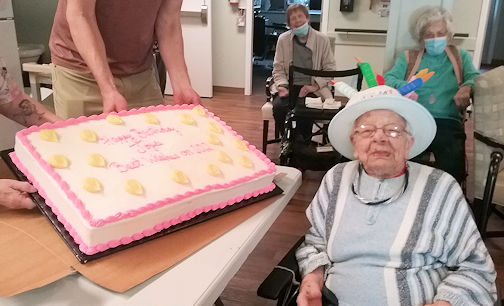 Joyce Van Dam of Tiverton Park Manor celebrates her 102nd birthday; photo by Karen Ballok
I remember the living conditions in the apartment at the mink ranch as being about as bad as they could get. It was a small basement apartment next to a garage or shed that was used to dry mink pelts. It was damp and smelly. I became sick with jaundice and Bill set out to find better living conditions.
When Bill arrived in Canada, he began to take correspondence courses to study accounting. He studied from 1954-57 by correspondence. From 1957-63, he attended McMaster University one day each week, and received his accounting degree in 1963.
Even in the tough times, I never really felt homesick or wanted to return to Holland. My family and I were happy in Canada. The one thing I found difficult was the language. I remember there were times when I made mistakes because I couldn’t understand the language.
In 1955, we bought a house for $1,500. It was close to the mink ranch. It was unfinished and had an upstairs. Bare lightbulbs were hanging from the ceiling, and it had an outhouse in the shed. In a few years, we changed it into a modern house. We did most of the work ourselves.
1957 was a very busy year for the Van Dam family. Bill left the mink ranch and began to work for a hardware manufacturing firm, Larsen and Shaw. We also bought a car.
When Harry was in school, I got a part-time job filing papers at income tax time. That was my first job in Canada. After that, I worked for 15 years for the health unit in Walkerton. I started out cleaning toilets and floors, and finished up as secretary for the head nurse.
With the boys in school, they began to play with the neighbourhood children. The Van Dam boys made friends with the Wismer children. Evelyn Wismer was an English war bride who was lonely, and she and I became friends. Also, Jack Wismer and Bill became good friends. Our two families often set out on weekend car rides together, and these car rides eventually led to Inverhuron. While visiting the area, Bill and I often attended Knox Presbyterian Church in Tiverton.
In 1960, Bill bought a piece of property in Inverhuron at the stony beach end. We had to clear it to build a cottage which was built by John Matheson and his brother. After a few years, Bill decided he wanted a basement and with the help of me and the children, we started taking stones out on the weekends when we came up. We kept supporting the foundation with cement when a small piece was done.
In 1970, Bill and I moved to Inverhuron and continued to drive back and forth to Walkerton every day to work for a number of years.
Soon after, we moved to Inverhuron and became members of Knox Presbyterian Church in Tiverton where I have been a member ever since. Bill soon became an elder on the session where he served for many years. He also played the organ with enthusiasm for 20 years.
In 1976, Bill decided to go out on his own with his accounting business and set up an office in Inverhuron. And along the way, we never stopped building!
The Lord has blessed us so much in our lives.
When pressed for some words of wisdom, it is difficult to answer in a few words. But here are some thoughts: Live close to Christ and the Holy Spirit will show the way; Love is the most important thing in our lives; Be helpful to everyone; Don’t waste energy with anger.
 Written By
No bio for this author.



Related Stories
No related stories.