Local hairstylists want province to cut the red tape so they can cut hair
While most local retail establishments and restaurants have opened their doors, at least partially, hairstylists in the Kincardine area are still not allowed to return to work, due to the COVID-19 (Coronavirus) pandemic.
And they say that’s not fair.
Rachel Mackay, who owns and operates First Impressions in downtown Kincardine, has been shut down for months.
“Since the pandemic hit in March, 2020, we have been closed more than we’ve been open,” she says. “We closed completely from March 17 to June 12, 2020, and again Dec. 25, 2020, to Feb. 16, 2021. And once more, from April 1 until now, with the hope we can re-open July 2.”
She says the pandemic has had a huge impact on her business.
“We have unrecoverable lost sales/lost business and income,” says Mackay. “We’ve seen big changes in services, staffing and how we work, when allowed, due to reduced capacity limits.”
She says that she was on unpaid maternity leave from Feb. 26 to April 15, 2019, which reduced her revenue for that year, and the Canada Revenue Agency based its pandemic support on what you made in March-April, 2019, compared to March-April, 2020.
“Even if I had personally qualified for every program offered, I still would not be even,” she says. “The lost revenue is the hardest hit. I have applied for rent relief and CERB (Canada Emergency Response Benefit) but I have not seen any yet for 2021. I had a bit of rent relief for partial months when we were closed in April and May, 2020.”
Mackay says it’s not fair that hairstylists are unable to work during some of the shut-down periods, as dictated by the provincial government, due to COVID-19.
“Hairstylists are exceptionally qualified in infectious diseases control,” she says. “We have always had health board inspections and are responsible to public health. Contact-tracing and other protocols have always been in salons for prevention of Hepatitis, HIV, and other infections. We also have been submitting safety plans to public health, while retail settings have not been required to do so.”
Mackay says the federal government, the province, Huron-Bruce MPP Lisa Thompson, the Grey Bruce Health Unit, and the College of Trades need to get on the same page.
“The Grey Bruce medical officer of health’s office said we were to remain closed due to the stay-at-home order which was over, as of June 2,” she says. “Lisa Thompson’s office was misinformed and said we aren’t regulated but we are, and we’re licensed to operate. There is no data to support that licensed stylists in personal-service settings are contributing to the COVID-19 spread; in fact, we are a huge part of prevention.”
Mackay says she would like the province and its health experts to show hairstylists the data that their sector has contributed to the spread of the virus.
“Any outbreak nation-wide has been in a hot spot, chain environment (such as the Greater Toronto Area) or a nail salon breaking the protocols (over-serving, no masking, no cleaning, etc.),” she says. “Aesthetics isn’t a licensed trade in Ontario. It is unregulated in training and is regulated by public health for cleanliness only.
“Hairstylists are trained and inspected. We answer to the College of Trades, the Grey Bruce Health Unit, and Ontario Public Health. We are the only trade not supported by any governing body so that we can continue working during the pandemic, or with any governing body we report to.
“Licensed stylists have also been one of the only industries to have, and hold, extra COVID-19 certification training through our professional organizations and by direction through Infectious Diseases at the health unit.”
She says dentists, massage therapists, chiropractors and stylists in some nursing home facilities are allowed to operate as essential, but are doing all services, including relaxation massage, dental cosmetic procedures, and colours and perms, not just medical procedures or personal health, and are not inspected by public health the way salons are.
“Salons in nursing homes are inspected, and we support them being open,” says Mackay, “but we want to be open as well. We can’t sell a shirt or a meal like retailers and restaurants have been able to do curbside, and they haven’t been closed nearly as long as we have. They can buy more and sell more. We sell time, so once that appointment is over or missed or cancelled, we cannot recover it - ever. So, the longer we lose time, the more we lose and the more we cannot recover.”
Mackay says her guests have been supportive as much as they can be.
“We have relationships with so many of them in and out of the salon,” she says. “I’d like to thank ours for thinking of us, reaching out, shopping if they can, and trying to support us anyway they can. With the lockdowns, it’s been nearly impossible to serve them unless they want a shampoo or gift card. So, a few days of delivering a conditioner here and there definitely helps but it’s not enough to sustain business. I drive and drop selected days as it’s not enough to warrant in-salon pick-up.”
INSTYLE HAIR STUDIO
Shawna Small, who owns and operates InStyle Hair Studio in downtown Kincardine, echoes much of what Mackay says.
Her shop has been closed for more than eight months since the beginning of the pandemic, with limited capacity allowed in-salon when it was allowed to open.
“We have experienced extreme loss in business, and loss in sales due to on-line shopping (Amazon),” she says. “Many people have found alternatives to getting their hair done - a family friend cutting hair, boxed dyes - and many have decided to no longer colour their hair with all of the unknowns with the upkeep of a hairstyle.”
Small says the government has “given” support through a “loan” of $60,000 which if paid by a certain date, $20,000 is forgiven.
“Although this will be another taxable income, we had no choice but to take this loan as we have been in an awful situation with zero income and zero support,” she says. “The emotional and mental part to all of this is just as extreme as the financial part.”
She says it is absolutely unfair for hair salons to be closed for most of the pandemic.
“It makes no sense at all as we are trained in sanitation and disease control and are closely monitored throughout the year with inspections from the health unit,” she says. “There is nothing more that we could do in order to make our place safe, as we are following protocols to the fullest. The health unit was in for a surprise inspection before Christmas and her exact words to me were: ‘You passed with flying colours.’
“I would like Ontario premier Doug Ford and his government to prove to me why? I want numbers and reasons as to why we were such a huge target during this pandemic.”
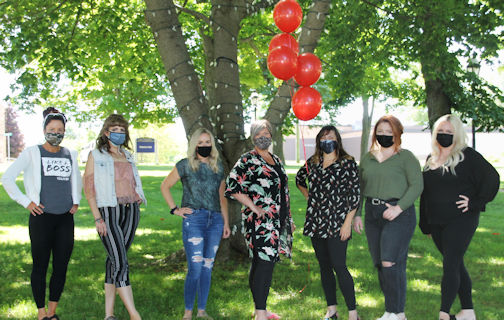 Standing with red balloons, indicating their frustration at having their salons remain closed due to COVID-19, are Kincardine hairstylists Shawna Small (left), Katie St. Jean, Shannon LeBlanc, Stacy Wise, Rachel Mackay, Courtney Dales and Danielle Mullen
HAIR CONNECTION
Danielle Mullen and Courtney Dales, co-owners of the Hair Connection in downtown Kincardine, have been open a total of eight months since last March.
“We took over ownership of the Hair Connection in October, 2020, and since then, we have been closed half of that time,” they say.
“The pandemic has impacted our business in many ways but our biggest disappointment is the loss of opportunity as new business owners. We also feel deeply for our staff who have had to rely on Employmenet Insurance or CERB multiple times in the past year."
Mullen and Dales have been lucky enough to qualify for government grants. Although not comparable to their lost revenue, it has helped with the bills that don’t stop while their doors are closed.
“All small businesses have taken a huge hit during the pandemic, and we can sympathize with the struggle they have gone through and celebrate with our friends in the industries that are able to open before we can,” they say. “We do feel that our industry has been unfairly treated. We have some of the highest health and safety standards (some that were even in place pre-pandemic). The safety of our guests and staff is the most important thing to us. We do feel that visiting the salon is just as safe as other businesses that are open at this time.”
To Ford and his panel of experts, they would say that their guests, some even in the medical field, have noticed and applauded their disinfection regimens.
“We have jumped through all of the hoops that we have been asked to since day one, and even with all of the extra PPE (Personal Protective Equipment) and sanitizer, rearranging our salon layout to ensure proper social-distancing, screening, and disinfection of all surfaces, we are still unable to return to work.
“We would also say that to some people, a hair cut is just a hair cut, but for a lot of our guests, it is so much more. After many conversations with our guests over the past few months, it is obvious that we are essential to them. For their mental health, and their self-confidence. Please consider the real people behind our businesses when you are just pushing us aside like our industry doesn’t matter.”
Mullen and Dales thank their guests for their loyalty and support throughout the pandemic. “And to our colleagues in the industry who continue to stand with us and fight for our rights as stylists and business owners. We cannot wait to get back to work and we hope it is in the very near future!”
KATRINA SMILEY
Katrina Smiley, former owner and current employee of the Hair Connection, says the salon has been open about seven-and-a-half to eight months since the pandemic began.
“It has had a huge impact,” she says. “It was three out of my last six months owning my business and literally thousands of dollars in lost revenue and income.”
“But that’s the least important part. In our profession, we have friendships with our clients and care about them and what’s happening in their lives, such as weddings, graduations, special events that we are used to supporting our clients though. We haven’t been able to do that. I had clients move away and pass away during the shut-downs, and I won’t ever get to see them again.”
Smiley says she received some government support for her business, at the time of the first shut-down, but nothing personally. However, she maintains a contract job, supporting Canadian and international stylists with virtual hair education which has been supplementary to her work. But she’s used to working two full-time jobs!
As for hair salons being closed through most of the pandemic, Smiley says that makes absolutely no sense!
“We are licensed specifically in sanitation and disease prevention,” she says. “To be honest, if we were irresponsible with our practices, salons could be high-risk environments. But we are diligent, inspected and extremely responsible with our practices and compared to the capacity and other public areas open, there is no just reason for us to maintain closure, not to mention that stylists and make-up artists who work in film, television and commercial production are allowed to work - but we are not.”
Smiley says everything being done at the Hair Connection currently is 100-per-cent adequate for handling the environment during a pandemic, as well as providing a safe, welcoming inclusive environment for every human.
As for Ford and his government, she would like to tell them a few things, but the main questions are: What evidence do they have to support salons being closed? And what is being done to better support this industry in Ontario so it has equal representation/opportunities as other retail establishments?
Smiley says she is grateful for the clients’ loyalty and support during this time.
“Every way you support, advocate, and purchase from us, it helps us so much,” she says. “We know it isn’t easy. It’s really hard responding to hundreds of messages from clients that you know you will disappoint time and time again when you tell them you still can’t cut their hair, or help them cover up their roots.
“We have to work, we want to work, we want to be able to earn a living, and get back to living the lives we are used to, and have worked hard for. The people I know who have been in this industry for any length of time, do it because they love it. That’s all. And it’s hard when something you love is taken away from you and you don’t get a choice about it."
DYNAMIC HAIR DESIGN
Stacy Wise of Dynamic Hair Design in Kincardine, says hairstylists have been treated very unfairly, and should have been able to re-open in Step 1, “but l feel as if Ford has an agenda and he will only do what he wants to do. So, we just have to hang in for a little longer and we can only hope that we won’t be shut down again.”
Hairstylists are set to re-open in Step 2 which was originally slated for July 5, but may be advanced to July 2.
 Written By
Liz Dadson is the founder and editor of the Kincardine Record and has been in the news business since 1986.



Related Stories
No related stories.