Kincardine’s Station Beach made history Wednesday morning, as it became a pilot project for Smart Beach technology, the first of its kind in North America.
Dr. Chris Houser, lead researcher behind this technology, said the three-year project stems from a partnership among the Municipal Innovation Council, the Municipality of Kincardine and Bruce County, with the goal of keeping residents and visitors safe at the beach.
“We’re looking to build a stronger technology and produce the best safety plan for this beach,” he said, standing on Station Beach, along the shores of Lake Huron, just prior to the launch of the project.
“We’re bringing in new technology to monitor how the waves are moving, and the currents. We want to study how people are using the beach – when and where. And we want to develop a dynamic warning system that is locally-calibrated for Station Beach.
“There are other warning systems used throughout Canada and the United States, but they are a one-size-fits-all. Station Beach is different than the others. It’s not your standard red, yellow and green lights.”
Houser is Dean of Science and a professor in the School of Environment at the University of Windsor. He plans to bring four or five students from that program to work on this project.
“What we want is to use the Smart Beach technology here as a model,” he said. “Then, hopefully, we can expand it to other Bruce County beaches and across Ontario.”
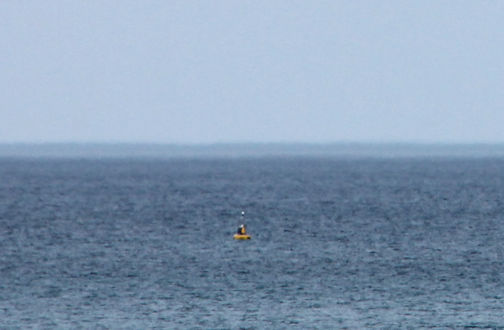
He said the first sensor went into the water Wednesday morning. It’s a yellow buoy placed about a half-kilometre offshore, lining up with the breakwall. More will be added, including water level and wave sensors, as well as traffic and pedestrian sensors, along the shore and on the pier.
This yellow buoy is the first sensor placed in Lake Huron, about a half-kilometre offshore from Station Beach, Kincardine, part of the Smart Beach pilot project which was launched Wednesday morning
Houser said one major focus will be on rip-currents and how they develop in the lake. Researchers will use the data collected to provide residents and visitors with highly-accurate, real-time local beach forecasts on rip-current locations, rough surf, and dangerous areas to avoid.
He said the first year of the pilot project will concentrate on waves and currents. In the second year, the focus will be on educating people about beach safety and how best to deliver that information, and then producing a beach safety plan.
The final year will be gathering everything together and ensuring it all works, he said.
Becky Smith, director of the Centre for Municipal Innovation at the Nuclear Innovation Institute, welcomed everyone to the launch of the Smart Beach pilot program.
“We’ve had such an incredible response from the community so far,” she said. “I’m excited to see where we can expand this project over the three-year pilot and beyond.”
Kincardine councillor Doug Kennedy echoed those sentiments as he welcomed everyone to the municipality.
“Beach safety is so important – here and around the county,” he said. “We are excited to host this project. It will benefit our residents and the thousands of visitors who come to our beach every year.
“We look forward to the data that Dr. Houser’s team will compile and analyze,” said Kincardine fire chief Brad Lemaich. “Being able to have predictive tools will allow Kincardine to provide beach-users the knowledge to enjoy a safer experience at Station Beach. The information will also help to minimize first-responder risk levels if we are called to the scene.”
There have been five drownings at Station Beach in the past 13 years, including Michael Hancock in 2008, French exchange student Oksana Milovanovic in 2010, Laslo Illy in 2013, Lucas Johnson in 2015, and Aleem Ramji in September, 2020.
“The ultimate goal,” said Houser, “is to decrease the number of drownings at Station Beach. We can then use this model at beaches across Bruce County and all over Ontario.”
The initial investment for the Smart Beach project was provided by the Municipal Innovation Council. From that investment, the county and Houser have secured an additional $260,000 of funding through Mitacs Accelerate.
Learn more about the Smart Beach project at smartbeach.ca.
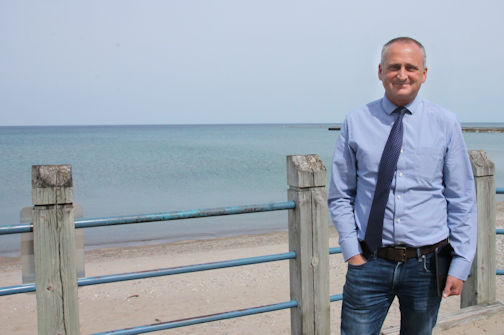
Dr. Chris Houser, Dean of Science and professor of the School of the Environment, at the University of Windsor, stands beside Station Beach, Kincardine, on the shores of Lake Huron
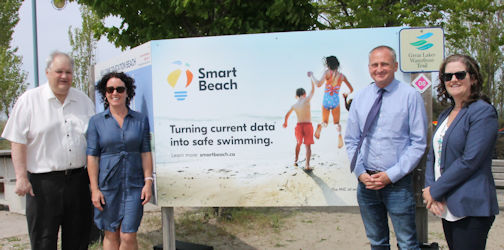
Gathered Wednesday morning to launch the Smart Beach pilot project at Station Beach, Kincardine, are Kincardine councillor Doug Kennedy (left), Becky Smith, director of the Centre for Municipal Innovation at the Nuclear Innovation Institute; Dr. Chris Houser, Dean of Science and professor of the School of the Environment, at the University of Windsor; and Kara Van Myall, chairperson of the Municipal Innovation Council
Dr. Chris Houser, Dean of Science and professor of the School of the Environment, at the University of Windsor, talks about the importance of the Smart Beach pilot project to help prevent drownings at Station Beach, Kincardine, and across the Province of Ontario



 May 26, 2022
2324

Related Stories
No related stories.