Once Upon a Time: How radio came to Cargill
Henry Cargill made his fortune cutting pine in the Greenock Swamp, a fortune sufficient to found the Village of Cargill in 1879, midway between Paisley and Walkerton, and outfit it with the latest improvements.
He introduced the telephone in 1887. By the turn of the century, his hydro power plant on the Teeswater River provided electricity to the residents, who paid 25 cents per light bulb. The main street was lined with sidewalks and lit by electric lights.
As for how radio came to Cargill, the story is told in the 1995 “Yearbook” of the Bruce County Historical Society.
Until about 1930, very few people in town had a radio set. To follow a big event, you had to find one of the few sets in town. Cargill old-timer Tom Meyer remembered when he listened to the Jack Dempsey–Gene Tunney fight at Joe Schuett's implement shop. (Tunney won the famous Long Count Fight of Sept. 22, 1927.)
Elmer Weber owned one of the earliest radios in Cargill, an Atwater Kent. His son, Gerry, recalled the afternoon when Fred Anderson, Hugh Campbell and Jerome Cassidy came over to listen to a World Series game. Reception was bad and Elmer fiddled with the knobs until suddenly the radio emitted a puff of smoke and burst into flames. The men opened a window and chucked the set out the back.
This was the 1930s, the golden age of radio, when you could pull in stations from Buffalo, Chicago and further afield. Between 1922 and 1932, the number of commercial radio stations in Canada doubled to 77. In the United States, 12-million households owned a radio in 1930, and despite the Depression, this figure rose to more than 28-million by 1939.
Another Cargill man, Morley Wright, decided to copy a scheme used in Elmwood to feed radio programs to the homes of people without a receiver. He got his neighbours to pay to listen to the radio. He bought the most powerful set on the market and ran wires from it, strung between the telephone poles, to a horn loudspeaker in each house. The speaker had a control knob for on-off and volume. Wright charged 50 cents per month for his streaming radio service.
Wright’s little business did well. The village barber took two speakers, one for the shop at the front of the house, and one in the kitchen.
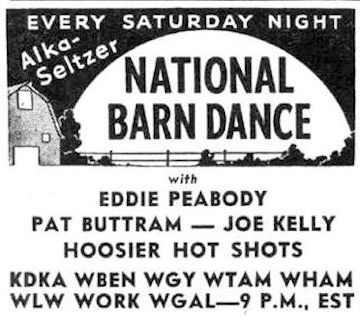
Subscribers loved listening to Jim Hunter with the news, Lum and Abner, Uncle Ezra, Amos and Andy, National Barn Dance and hockey. Of course, they had to listen to whatever station Wright was tuned to. That was a major problem Saturday night, when the National Barn Dance clashed with hockey. Wright got used to complaints along the lines of “turn off the damn Barn Dance, we want to hear the hockey game.”
Advertisement for the National Barn Dance radio show; WBEN broadcast from Buffalo (otrr.org)
Eventually, Wright sold his radio service to Norman Schuett whose wife operated the radio from her kitchen. The Schuetts introduced a new feature, broadcasting a Cargill band, “The Dixie Boys,” live from their living room. Started by Jerome Cassidy (violin), the Dixie Boys included Norm’s daughter, Bonnie (piano), Howard Chesney (drums) and Gerry Cassidy (vocals). A later addition, was Frank Fruin on saxophone and vocals. The Dixie Boys played at dances all through the Second World War.
Cargill history lives on at the Bruce County Bookstore. Owner Kevin McKague has declared Sunday, July 3, to be Bruce County Historical Society Book Day, showcasing many of the Society’s books on county history, such as “The Bruce,” and their authors, whom you may meet from 1-3 p.m. The bookstore is at the back of the Mill Pond Gallery in downtown Cargill.
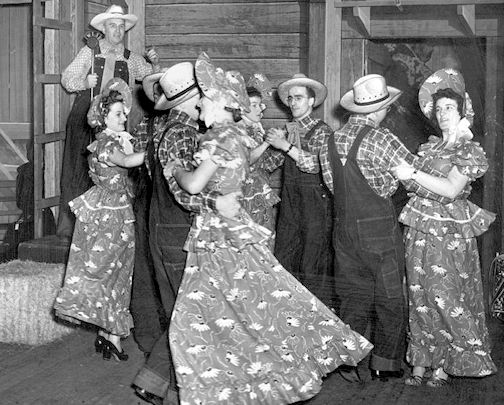
Square dancers in a 1940 publicity photo for National Barn Dance which aired on WLS Chicago from 1924 to 1950 (WLS Radio)
 Written By
No bio for this author.



Related Stories
No related stories.