Kincardine holds 39th annual Christmas Bird Count
Every December, birders across the globe unite in the world’s largest citizen science project, and collect data on Christmas Bird Counts. These events began as an alternate to the barbaric traditional Christmas side-hunt at which teams indiscriminately shot all birds and mammals just for fun.
The first Christmas Bird Count was held in 1901.
At a typical event, participants gather very early so they are ready to start counting at daybreak. This year, Kincardine conducted its 39th count Dec. 14. It was fortunate the group didn’t have to cancel because a Bruce County squall threatened to close roads.
About 20 participants, equipped with binoculars and smiles, scoured the count circle for their feathered kin. They searched from dawn to dusk and then united for the wrap-up and Christmas dinner. The mild and open winter weather means birds are more widely dispersed and harder to find. Feeder watchers noticed the decline and recorded fewer birds than normal.
A highlight for local birders were the many Red-throated Loons seen in feeding frenzies mixed with several other diving species, such as mergansers. Red-throated Loons are smaller than the Common Loon and hold their beaks on a slight upward angle. They nest in the high Arctic and migrate through the Great Lakes on their way to and from the eastern seaboard. Birders seldom get to see them in their namesake breeding plumage; most birds are in a drabber winter plumage.
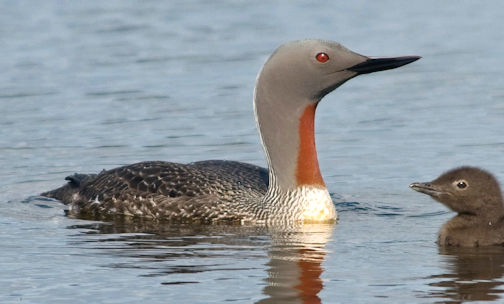 Red-throated Loon in breeding plumage; photo by David Karnå
Five species of gulls were seen on count day, including the Bonaparte’s. This small gull is unique in that it nests in trees on the taiga; most gulls nest on the ground. It has a buoyant and graceful flight and eats smaller organisms than its bigger cousins. It has a black head in breeding plumage but seen here in December, it has only a dark dot behind the eye.
 Bonaparte’s Gull in winter plumage; photo by Dick Daniels
Winter is a great time for gull-watching because there are about nine species possible. One of the best places to gull-watch is at landfill sites. In summer, just two gulls are abundant here, Herring and Ring-billed Gulls.
Normally, several Snowy Owls are found on count day but this is an off-year and there have been no sightings in the county. One red morph Eastern Screech Owl was found. Screech Owls come in two distinct colours, the more common-place morph depends on region and habitat.
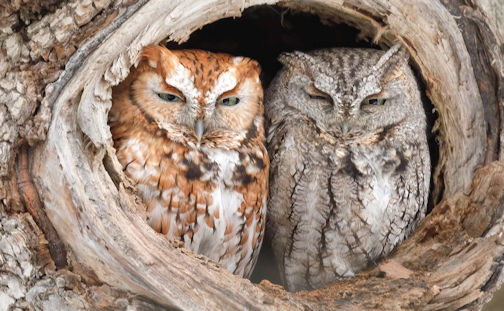 The two colour morphs of the Eastern Screech Owl; photo by Jack Starret
The 62 species found on this year’s count is the second highest ever. The 22 Cackling Geese reported was a new high. Cackling Goose is identical to the Canada Goose in plumage but is only about half the size. Also new to the count this year, was a duck called the American Wigeon.
The American Wigeon is also called "baldpate" because the white stripe on its head resembles a bald man. Wigeons are common here, in season, but have almost all left the county by December.
Local bird-watchers are always amazed at what birds the participants can find even in December. Congratulations and thanks to all who helped out with this year’s count. Following is a complete list of birds seen.
If you are interested in seeing any of these birds or joining the Bruce Birding Club, contact James Turland at
jaturland@gmail.com.
| SPECIES |
COUNT |
|
SPECIES |
COUNT |
| Canada Goose |
2,073 |
|
Belted Kingfisher |
1 |
| Cackling Goose |
22 |
|
Red-bellied Woodpecker |
4 |
| Mute Swan |
2 |
|
Downy Woodpecker |
13 |
| Mallard |
180 |
|
Hairy Woodpecker |
5 |
| American Black Duck |
8 |
|
Pileated Woodpecker |
2 |
| American Wigeon |
1 |
|
American Kestrel |
2 |
| Redhead |
28 |
|
Merlin |
3 |
| Greater Scaup |
55 |
|
Northern Shrike |
3 |
| Lesser Scaup |
30 |
|
Blue Jay |
40 |
| White-winged Scoter |
8 |
|
American Crow |
420 |
| Long-tailed Duck |
5 |
|
Common Raven |
19 |
| Bufflehead |
55 |
|
Black-capped Chickadee |
204 |
| Common Goldeneye |
66 |
|
Horned Lark |
2 |
| Common Merganser |
47 |
|
Golden-crowned Kinglet |
1 |
| Red-breasted Merganser |
149 |
|
Red-breasted Nuthatch |
3 |
| Wild Turkey |
35 |
|
White-breasted Nuthatch |
5 |
| Horned Grebe |
2 |
|
European Starling |
1,903 |
| Rock Pigeon |
340 |
|
Hermit Thrush |
1 |
| Mourning Dove |
57 |
|
American Robin |
26 |
| Ring-billed Gull |
784 |
|
Bohemian Waxwing |
1 |
| Herring Gull |
920 |
|
Cedar Waxwing |
84 |
| Bonaparte's gull |
13 |
|
House Sparrow |
21 |
| Glaucous Gull |
1 |
|
House Finch |
53 |
| Great Black-backed Gull |
1 |
|
Purple Finch |
3 |
| Red throated Loon |
27 |
|
Common Redpoll |
1 |
| Northern Harrier |
4 |
|
American Goldfinch |
235 |
| Cooper’s Hawk |
1 |
|
Snow Bunting |
466 |
| Bald Eagle |
7 |
|
American Tree Sparrow |
30 |
| Red-tailed Hawk |
7 |
|
Dark-eyed Junco |
228 |
| Rough-legged Hawk |
9 |
|
Common Grackle |
2 |
| Eastern Screech-owl |
2 |
|
Northern Cardinal |
34 |
 Written By
No bio for this author.




Related Stories
No related stories.