Once Upon a Time: Step back in time with farm diaries
What better way to learn about a pioneer settler’s daily life than by reading his/her diary?
In the Archives at the Bruce County Museum and Cultural Centre, there is a collection of 107 rural diaries written by 13 residents of Bruce County.
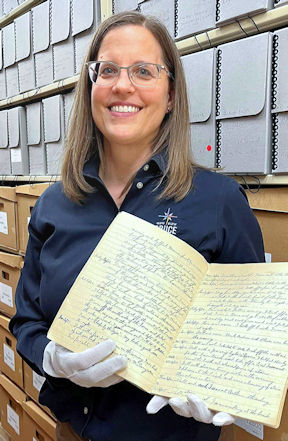
Archivist Deb Sturdevant (right) with a Burgess diary; photo courtesy of the Bruce County Museum and Cultural Centre
You can travel back to the 19th Century and follow the life of, for example,
Nathaniel Edward Leeder, Sr. (1835-1923). He and his son, Ed, kept diaries from 1854 to 1900. Dipping into their diaries reveals the daily social and work life of the Leeder family.
Nathaniel was only 16 when he emigrated from Norfolk, England, in 1851. After stops in Quebec City, Hamilton and Doone, Ontario, Nathaniel took up land in Saugeen Township in 1853. Finally, a year later, his parents, Robert and Hannah, and his three brothers, Robert Jr., Philip and Fred, arrived and joined him in the task of clearing the land. The Leeders were among the first to settle in the area — Robert Leeder was the first miller at Mill Creek near Port Elgin.
Nathaniel’s diaries are the oldest ones in the Archives. He starts Nov. 5, 1854: “This day I commence keeping a Memoranda of weather, work and business transactions. Cold with layer of snow.”
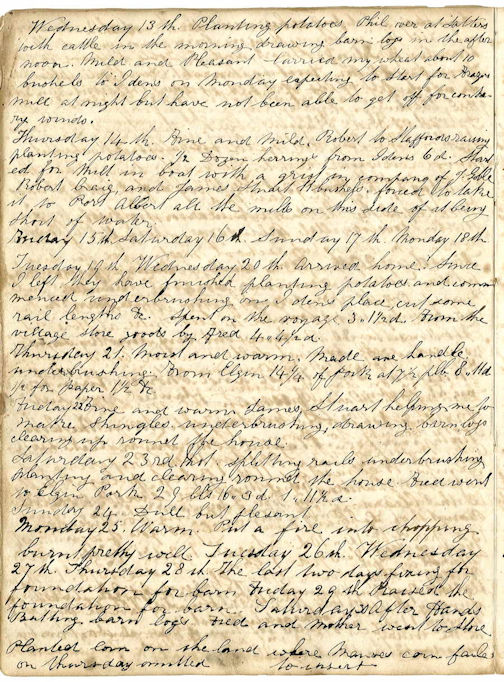 A page from the 1854 diary of Nathaniel Leeder; courtesy of the Bruce County Museum and Cultural Centre, A991.047.038-024)
He writes about buying herring packed in pork and whisky barrels, cutting logs for an ox shed, grinding corn, under-brushing, boiling pumpkins, tapping trees and boiling sap, drawing fence stakes, making shingles, raising a barn and buying goods from Ruby's store.
In 1855, he mentions planting at least 15 different seeds in his garden or fields, including beets, carrots, chicory, peach stones, peas, potatoes, onions, radishes, rhubarb, spinach, barley, corn, millet, timothy and wheat.
On top of working his farm, Nathaniel attended meetings about establishing a school in the area and later served on the school board. He also got involved in municipal administration, serving as Tavern Inspector, Inspector of Noxious Weeds, and Township Treasurer (1892-1914).
Nathaniel went to meetings of the West Bruce Farming Institute. In an Oct. 10, 1859, diary entry, we learn of an agricultural show: “Township show entered. ... Took second prize for fall wheat, first prize for onions, fourth prize for butter and first prize for carrots. Sold Henry Hilker two hundred bushels of fall wheat to be as good as that shown at the show and delivered in two weeks from this date.”
Nathaniel married Mary Caroline Schwendker (originally from Germany) in 1860 and had five children. They moved to Missouri in 1870 where Nathaniel acted as a postmaster and a schoolteacher. The family returned to Saugeen Township in 1874.
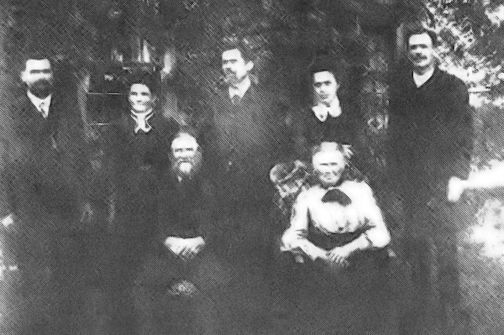 Nathaniel E. Leeder family; photo courtesy of Roots and Branches of Saugeen, 1854-1984)
The diaries of another farming family,
Elizabeth Oliver “Olive” Burgess (1896–1980), and her brother,
James “Rowand” Burgess (1898–1968
), of Arran Township, begin 10 years after the Leeders’ end. The siblings’ diaries (from 1911-74) record Olive working tirelessly on her uncle Alfred’s farm and Rowand working in the fields and cutting timber in the forest. Technology gradually came to the farm: a cream separator in 1916, a gravity washing-machine in 1917 and a Bell telephone at their uncle’s in 1918.
Olive and Rowand Burgess began writing as teenagers, and their diary entries between 1911 and 1918 mention social events, such as patriotic picnics, school box socials, literary society debates and a Leap Year party.
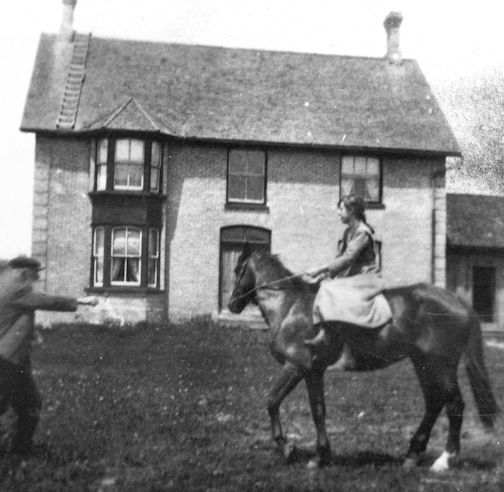 Olive Burgess on horseback; photo courtesy of the Bruce County Museum and Cultural Centre, A2014.008.0048
Many of the Leeder diaries are in fragile condition, so the Archives saw the need to digitize the collection to make it more accessible to the public. To date, six volunteers have transcribed more than 2,800 pages of rural and military diaries, which are available for on-line viewing at the museum’s “On-line Collections,” by entering the word
Diary in the Keyword Search box.
Making rural diaries more accessible is also the aim of the University of Guelph’s Rural Diary Archive (RDA). Launched by Dr. Catharine A. Wilson in 2015, the on-line database assembles more than 200 diarists from rural Ontario, writing from 1800 to 1960. With the help of volunteer transcribers, thousands of handwritten pages are being turned into searchable typescript. The RDA project encourages people to volunteer — the web site has full instructions on how to transcribe a diary.
Visit the Research Information page at
www.brucemuseum.ca for links to historic diaries and letters, including images of the original diary pages and links for downloading PDF typed transcriptions. You can join the Archives (
archives@brucecounty.ca) as a volunteer transcriber, or donate diaries written in Bruce County.
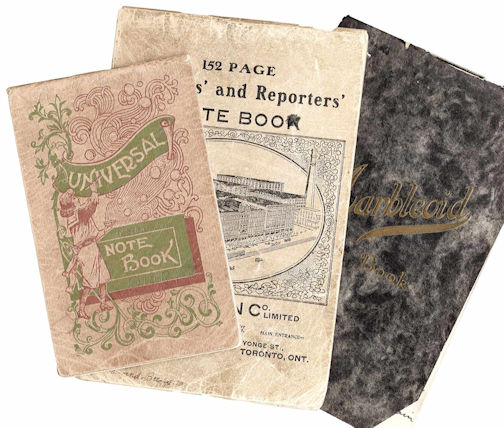 Burgess diaries; courtesy of the Bruce County Museum and Cultural Centre, A2012.087.001-003
 Written By
No bio for this author.



Related Stories
No related stories.