CNIC, IAEA highlight Canada’s first contributions to global Rays of Hope initiative
James Scongack of Bruce Power, chairman of the Canadian Nuclear Isotope Council (CNIC), travelled to the headquarters of the International Atomic Energy Agency (IAEA) in Vienna, Austria, Friday, for a meeting with General Rafael Mariano Grossi, IAEA director, to discuss Canada’s planned contributions to the global Rays of Hope initiative.
This discussion builds upon the practical arrangements signed by the CNIC and the IAEA in
March 2025, which set out a framework to leverage the CNIC’s network and existing relationships with Canadian industry partners, hospitals, and governments to encourage support for Rays of Hope.
Rays of Hope is a global cancer initiative led by the IAEA that aims to expand access to cancer care and radiotherapy infrastructure in low- and middle-income countries. Due to lack of access, these countries experience over 70 per cent of cancer deaths, yet receive only five per cent of global spending in this area. The Rays of Hope initiative is working to close this gap by delivering life-saving equipment, training, technical expertise and support to cancer patients in these countries when they need it most.
Since the initiative began in late 2022, more than 20 countries have contributed more than $105-million (U.S.) to support more than 30 countries around the globe. These projects have delivered essential radiotherapy and medical imaging machines, in addition to training for medical professionals to operate the equipment and provide diagnostics and treatments.
The announcement made Friday by the CNIC outlines Canada’s first ever set of in-kind contributions to IAEA activities in the area of isotope production for medical isotopes and will explore opportunities to develop:
- An isotope production and radiation safety training program to be primarily hosted at Bruce Power in 2026 to welcome a class of regulators from low- and middle-income countries, to learn about technical fundamentals of nuclear isotope production, processing, and radiation safety culture.
- A proposed multi-disciplinary technical training program, hosted at the London Health Sciences Centre and St Joseph's Hospital, leading Canadian hospitals, that covers hands-on training in radiochemistry and production, radiolabelling, quality control, dosimetry, medical imaging, patient delivery, and more, in support of the Rays of Hope initiative.
- The development of an IAEA- and Canadian-made collaboration on E-learning and virtual training packages. Under this activity, the CNIC will leverage resources, materials, and in-house expertise within its member companies and organizations, which can be deployed by the IAEA to support low- and middle-income countries.
“This announcement reflects the next step in our committed, forward-looking partnership between Canada and the IAEA,” said Scongack. “While we recognize Canada’s current leadership in the global medical isotope community, we also must acknowledge that we face a responsibility to take an active role in supporting increased access to life-changing isotopes for patients around the world.”
“Together, we are expanding the reach of life-saving technologies,” said Grossi. “By combining Canada’s strengths in isotope production, processing, and quality control, with the reach and expertise of the IAEA Rays of Hope initiative, we are helping countries build the professional competence needed to deliver safe and effective treatments.”
“As Ambassador of Canada to the United Nations in Vienna, I can confirm our strong commitment to strengthening global health through collaboration and technical expertise,” said Alison Grant. “Through its extensive leadership in medical nuclear isotopes, Canada is proud to support the IAEA’s Rays of Hope initiative, helping expand access to life-saving cancer diagnostics and treatment in countries that need it most.”
To support next steps, the CNIC and IAEA have established a technical working group to advance on the three areas of activity, working to deliver the training programs and E-learning materials toward the end of 2026.
The Canadian Nuclear Isotope Council is an independent, not-for-profit advocacy and member services organization. It supports more than 115 members from across science, academia, health care, and nuclear-sector organizations dedicated to maintaining Canada’s position as a global leader in the production of life-saving isotopes. The CNIC raises awareness and advocates for long-term policies that support health-care innovation and will save countless lives for decades to come.
To learn more about the CNIC, visit
www.CanadianIsotopes.ca and follow it on
Facebook,
Twitter, and
LinkedIn.
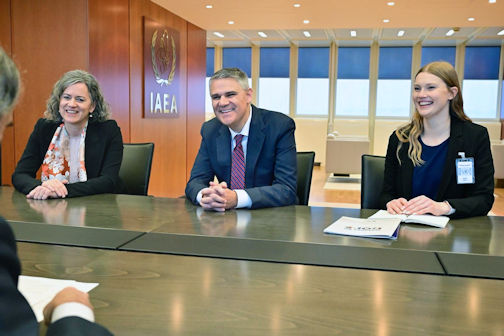 James Scongack (centre) of Bruce Power, chairman of the Canadian Nuclear Isotopes Council (CNIC), is joined by Alison Grant (left), Canada’s ambassador to Austria and permanent representative to the international organizations in Vienna, and Melody Greaves, CNIC executive director and vice-president, government relations, in a meeting with IAEA director General Rafael Mariano Grossi in Vienna, Austria, Friday, Feb. 20
 Written By
No bio for this author.






Related Stories
No related stories.