NIMBY: Nature In My Back Yard – Every day is Earth Day
The first Earth Day took place April 22, 1970, in the United States, following a massive oil spill off the coast of California in 1969. Millions of Americans participated in teach-ins, rallies and clean-up projects, reflecting growing public consciousness of the harmful effects of pollution on the environment.
The Earth Day movement went international in 1990 with 141 countries organizing events, including Canada, and today, promotes environmental protection and sustainability through activities in 192 countries.
Municipalities, schools, environmental groups, horticultural societies, conservation authorities, and others organize a great variety of educational, hands-on activities which are easily found on-line.
As the focus of my writing is environmental stewardship and sustainability in the garden, for Earth Day, I’d like to share information about a tool I find invaluable and a project I wholeheartedly support.
Whether I’m browsing a garden centre, picnicking in a park, admiring someone’s garden or walking on a trail, I’m constantly trying to identify plants and insects. The iNaturalist app on my phone has become essential not only for the service it provides me but for the service I provide to others by using it.
iNaturalist is a joint initiative of the California Academy of Sciences and the National Geographic Society. In Canada, it’s under the umbrella of the Canadian Wildlife Federation. It began in 2008 as a Master’s final project of three students at the University of California Berkeley School of Information. In 2023, it became an independent non-profit.
After creating a free account on-line at
www.inaturalist.ca/signup and downloading the app on their phones, users are able to record, share and identify observations of plants, animals and fungi, worldwide.
Making observations is easy. Participants upload photos or sound recordings of organisms from their phone or computer. Using artificial intelligence, an extensive database and the scientific community, the app suggests possible matches and provides photos for comparison. Experts in various fields of natural science work behind the scenes to confirm identification, and report back via E-mail notices. Instructions and tutorials are easily found on the website:
help.inaturalist.org/en/support/solutions/folders/151000552105.
I find it useful for basic identification and to learn if a plant I encounter is native to my area or where it’s been observed in my vicinity. It’s a very sophisticated tool for learning about nature but personal observations are only one aspect of its usefulness.
As a community science forum, every observation made generates valuable biodiversity data that can be used by scientists. When two or more users agree on an identification, it becomes “research grade” and can be shared with global databases.
Users can also search for projects on specific topics, such as Monarch butterfly migration or tracking bumblebees. Projects collect data on particular locations, including national and provincial parks, nature reserves and conservation areas. They can be ongoing or short-term.
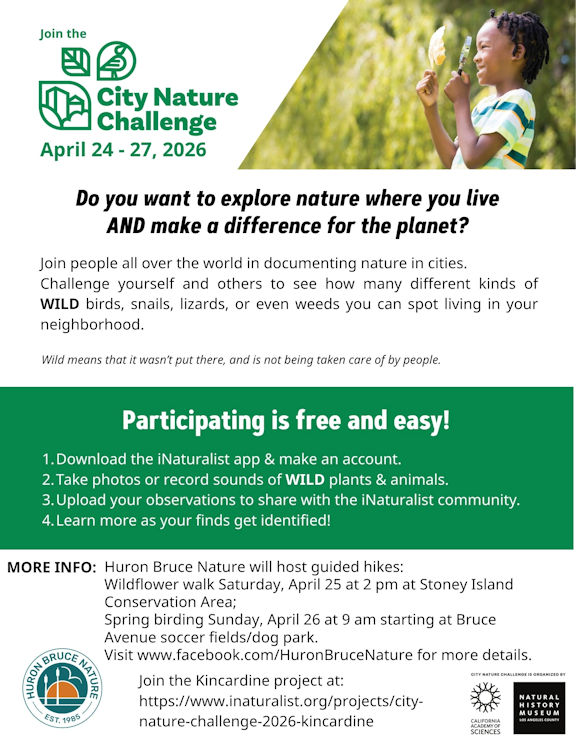
To celebrate Earth Day, the California Academy of Sciences and the Natural History Museum of Los Angeles County organize an international bio-blitz using iNaturalist, called the City Nature Challenge. With the goal of connecting people in cities to nature while contributing to science, the four-day event runs April 24-27 and encourages people to explore nature in their surroundings by making observations of wild things: plants, animals, insects and fungi that are naturally occurring, not placed by humans.
This year, 669 cities are registered across 63 countries. In 2025, nearly 103,000 people made 1.3-million observations of more than 73,000 species.
The City Nature Challenge in the Municipality of Kincardine is being organized by the Huron Bruce Nature Club for the third year running. The project can be found at
www.inaturalist.org/projects/city-nature-challenge-2026-kincardine.
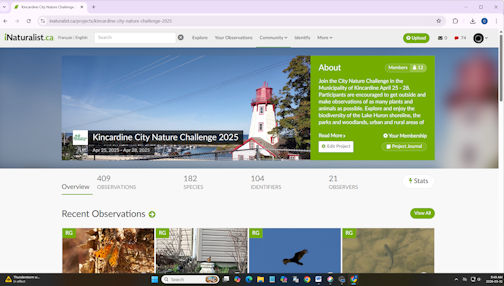 City Nature Challenge 2025 results for the Municipality of Kincardine, showing the number of observations, participants and identifiers
Any observations made on iNaturalist within the boundaries of the municipality during the four days of the challenge, will automatically become part of the project.
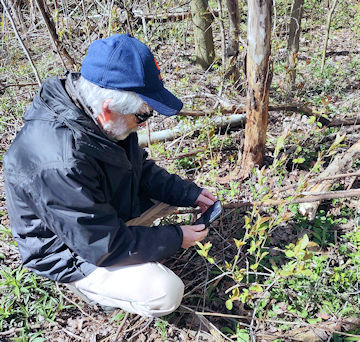
Jim Roberts makes an observation of a plant using the iNaturalist app on his phone
The club is hosting two guided walks: Saturday, April 25, at 2 p.m., at Stoney Island Conservation Area, and Sunday, April 26, at 9 a.m., at the Bruce Avenue soccer fields. Members of the public are welcome to attend.
Community groups, individuals and families are also encouraged to explore the rich diversity of the Lake Huron coastal areas, forests and trails on their own. The Seek app by iNaturalist is a child-friendly version that provides identification but does not share location data.
Regardless of whether you participate in this global bio-blitz event, iNaturalist is a valuable tool to build your knowledge, connect with experts, and contribute to science. Search the projects to find one or several with missions that interest you or start your own.
Either way, start making observations and consider this quote from David Suzuki: “Nature surrounds us, from parks and backyards to streets and alleyways. Next time you go out for a walk, tread gently and remember that we are both inhabitants and stewards of nature in our neighbourhoods.”
 Written By
Christine Roberts is a retired elementary school teacher, president of Huron Bruce Nature, member of the Ripley and District Horticultural Society, volunteer for the David Suzuki Foundation, VON volunteer fitness leader and a passionate lover of nature.



Related Stories
No related stories.