Bruce County Memories: Steamer "Ploughboy" comes to town — a boon to Bruce County
Travel to Bruce County in the mid-1850s was difficult. The few roads were often in poor condition. Travel by horse, buggy and stage coach, and by sleigh in winter, was often arduous. Bad weather wreaked havoc with the schedules of schooners sailing on the lake. Railways were years in the future.
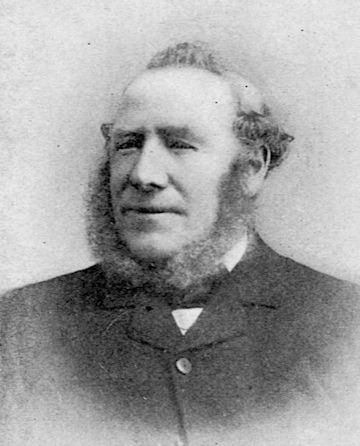
All this changed in 1856 when Captain Duncan Rowan announced that the side-wheeler, "Ploughboy," would start service from Detroit, touching at Windsor, Sarnia, Bayfield, Goderich and Saugeen, the first steamer to sail regularly on that route.
Captain Duncan Rowan; photo courtesy of Norman Robertson
"Ploughboy" had been built in Chatham for W. and W. Eberts, and was launched June 24, 1851. Its first route was between Chatham, Amherstburg and Detroit, through to the end of the 1853 shipping season. In March, 1854, "Ploughboy" was purchased by Park and Co. of Amherstburg and put on the Port Stanley-to-Buffalo route, stopping at intermediate ports on Lake Erie. She carried passengers and freight, and was commanded by Captain S.S. Hollywood.
This "North Shore Shuffle" would continue until the end of 1855. During that winter, "Ploughboy" was totally refurbished, and the "Windsor Herald" proclaimed that she now "… universally admitted to be the safest boat of her size on the Lakes."
Her route changed again to the benefit of those wanting to travel to Bruce County. She now plied between Detroit and Collingwood, with regular stops at Goderich, Kincardine, Saugeen (Southampton), Owen Sound (Secord's Dock) and Meaford (Stevenson's Dock).
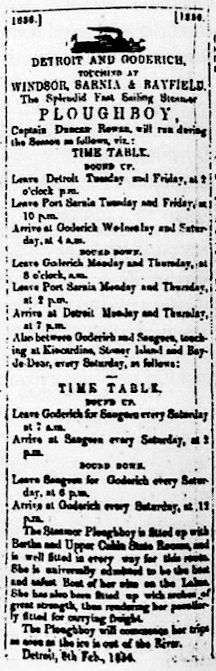
At Kincardine, "Ploughboy" would drop anchor out from the piers and a scow would be rowed out to offload passengers and freight. Being rowed ashore was the experience of Arthur G. Robinson, chief engineer of the Federal Board of Works, who was overseeing the construction of Chantry Island Lighthouse. He noted in his diary for Aug. 3, 1856, that he waited for "Ploughboy" at Stoney Point, left there and proceeded to Saugeen where he landed at 3:15 p.m., and was "... sent ashore in skiff — nearly swamped."
1856 advertisement for "Ploughboy;" photo courtesy of the "Windsor Herald," Feb. 8, 1856
Park and Co. also won a contract to carry mail from Detroit and Windsor to Lake Huron ports. This greatly improved local postal service. Political intrigue and chicanery were factors in gaining and retaining these lucrative contracts. "Ploughboy" was not immune to this process.
Disaster struck May 1, 1856. "Ploughboy" grounded when she was entering the Saugeen River. The "Chatham Planet" of May 16 wrote, "By telegraph we have just received news that 'Ploughboy' was run on rocks at the Saugeen Harbour, and supposed to be a total loss." In the following issue, a clarification: "The steamer, 'Ploughboy,' as we noted last week got ashore at Saugeen — she got off without any material damage, but on her passage down the lake by some derangement taking place in her machinery burst her cylinder, and had to be taken in tow by the 'Canadian' who took her down to Detroit on Saturday last, where she will undergo repairs."
In the meantime, another Park-owned vessel, the steamer, "Mohawk," took her place on the route. The Saugeen accident was also reported in the "Buffalo Daily Republic" of May 12. A week later, the "Republic" noted that repairs to "Ploughboy" had been completed and she had resumed her trips between Detroit, Goderich and Saugeen.
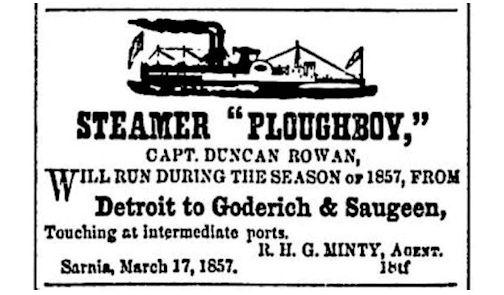
In 1857, "Ploughboy" was back on Lake Erie, but also continued to visit intermediate ports on Lake Huron and was due to stop at the newly-constructed pier at Port Bruce.
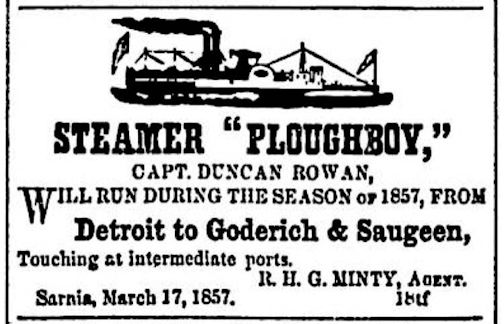 "Ploughboy" runs from Detroit to Saugeen in 1857; photo courtesy of the "Sarnia Observer, March 7, 1857
At the end of the 1857 season, "Ploughboy" came upon the schooner, "D.B. Sexton" in “hapless condition” off Clark’s Point and towed the disabled vessel to Goderich Harbour. In addition, Captain Rowan was heralded for being instrumental in saving the lives of the crew of the schooner, "Gamecock," near Goderich.
"Ploughboy"’s shuttle service was readily taken advantage of. Increased demand resulted in the steamers, "Canadian" (formerly "Canadian Lily") and "Kaloolah" also being put on this route.
In 1858, "Ploughboy" established her home port at Collingwood. From there, she extended her route northwest to Bruce Mines, Sault Ste. Marie and Fort William. This service would continue until the end of 1863.
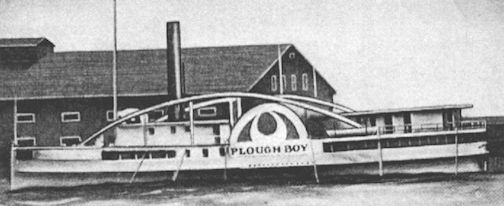 "Ploughboy docked at Collingwood Harbour after 1856; photo courtesy of the Collingwood Museum
In 1864, "Ploughboy" was renamed the "T.F. Park" and relocated, once more, to Essex County. There, she operated on the Detroit River, Lake Erie and Lake St. Clair as a wrecking tug, tow boat and excursion steamer.
Unfortunately, her days on the Great Lakes ended June 3, 1870. While undergoing refitting to, again, be put on the Port Stanley-to-Cleveland route, she caught fire at Sibley's Dock in Detroit. The vessel was destroyed and sank. Then, in October, after a legal dispute with the City of Detroit, was scuttled in the deep waters of Lake Erie.
With her efforts to improve transportation to Bruce County and environs, "Ploughboy" played an important yet often overlooked part in the maritime history of the region and Ontario. In addition, she should be remembered as a positive influence in the development of Bruce County, something we can all be thankful for.
Dr. John C. Carter is Peninsula director for the Bruce County Historical Society and author of "The Perils and Pitfalls of the Steamer Ploughboy." A copy is available through jrph@erca.org and at the Bruce County Museum gift shop. Carter can be reached at drjohncarter@bell.net. This article was published in the historical society’s 2025 Yearbook.
 Written By
Dr. John C. Carter is Peninsula director for the Bruce County Historical Society and author of "The Perils and Pitfalls of the Steamer Ploughboy."



Related Stories
No related stories.