



 June 3, 2026
740
June 3, 2026
740
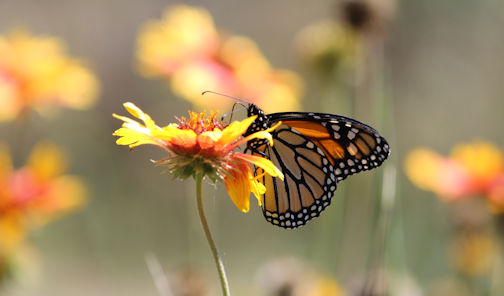
“To plant a garden is to believe in tomorrow.” This famous quote by actress Audrey Hepburn is one of my favourites. In just a few words, it captures the hope and optimism of gardening. If you’ve visited a garden centre this spring, you’ve probably experienced those feelings as you browse the endless rows of plants, envisioning the wonderful garden you’ll enjoy this year.
In the context of sustainable, nature-friendly gardening, this optimism drives us to support declining insect and bird populations through increased plant bio-diversity. To be honest, it’s sometimes hard to maintain hope but the sight of bumblebees and butterflies in my yard lifts my spirits.
Among the many beneficial native plants available for inclusion in our gardens, some are more valuable than others. They’re called keystone species.
In short, a keystone species is one that has a disproportionately large effect on the eco-system it inhabits. To put it in context, think of ancient architecture and the keystone block at the top of the arch that locks the other stones in place. Remove the keystone and the arch collapses.
In home gardens, a keystone plant species supports many more species of insects and critically, caterpillars and bees, with ripple effects up the food chain to the birds, bats, amphibians and reptiles that rely on insects for food. A landscape that includes plants that provide for the greatest number of edible insects is much more productive. To achieve this, we have to include keystone plant species.
Among native wildflowers, the main types of keystone species are sunflowers, asters and goldenrods.
Native sunflowers (helianthus) provide pollen for specialist bees and serve as host plants for more than 70 species of butterflies and moths. In fall and winter, birds and small mammals feast on the seeds, and cavity-nesting insects may lay eggs in the stems. The flowers are smaller than the large ornamental blooms which have been bred over many generations to maximize showy flower heads and seed production for the horticultural and agricultural trades.
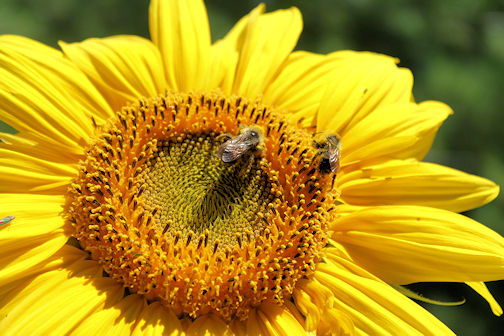
Ornamental sunflowers are derived from native species and will provide pollen and nectar but are less likely to act as host plants
In our gardens, Woodland Sunflower grows well in sun to part-sun in dry soil. The plentiful bright yellow flowers contrast pleasingly with dark stems. It’s easy to propagate from seeds.
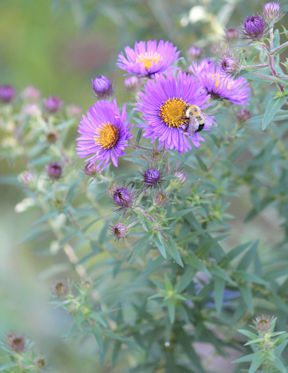 Asters are vital keystone plants, acting as host to more than 100 species of butterfly and moth caterpillars and support many specialist bee species. Blooming in late summer into fall, asters are a crucial food source for migrating Monarchs and bees preparing for winter hibernation.
New England Aster has the largest flower of the aster family
There are many different native aster species with a range of sizes, growing requirements and colours within the purple and white palettes.
New England Asters are the showiest with large, bright purple flowers. They prefer sun and can grow quite tall. They are generous self-seeders in several of my gardens.
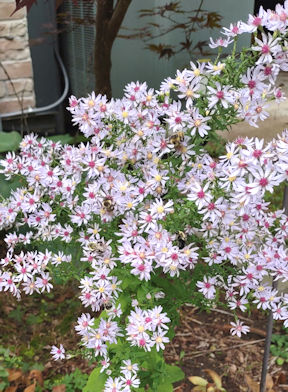 The Heart-Leaved Aster is adaptable but prefers part shade. They grow to a medium height and the clusters of delicate pale blue flowers are among the last source of food for butterflies and bees in fall.
How many bumblebees can you spot in this photo of Heart-Leaved Aster taken Oct. 14, 2025?
Goldenrods (Solidago) are terribly maligned and misunderstood. They are accused of causing hay fever, but their pollen is too heavy and sticky to be airborne. The likely culprit is ragweed which flowers at the same time. This keystone family of plants, like asters, is host to more than 100 species of caterpillars and a food source for many specialist pollinators.
With more than 25 native species of goldenrods in Ontario, it’s easy to find the right fit for your garden. Most people are familiar with Canada Goldenrod and its aggressive spreading nature. However many species, like Stiff Goldenrod, are well-behaved and provide clusters of tiny, bright yellow flowers that are pollinator magnets.
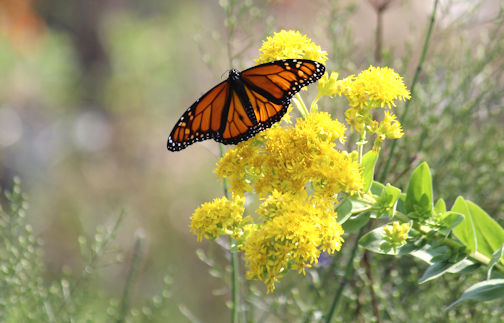
There’s a native goldenrod for every garden niche; Stiff Goldenrod is a magnet for all types of insects and is a crucial food source for migrating Monarchs
Until fairly recently, White Upland Goldenrod was classified as an aster. It is low-growing, prefers full sun and is very drought-tolerant.
Some reference materials include coneflowers in the category of keystone wildflowers. There is some difference of opinion whether they qualify since they aren’t host to as many species of insects but are a highly-valuable food source for bees, butterflies and birds in fall.
Two important native coneflowers are Pale Purple Coneflower (Echinacea pallida) and Grey-headed Coneflower (Ratibida pinnata).
Pale Purple Coneflower has delicate drooping mauve petals and is drought-resistant. It’s hardy and will self-seed.
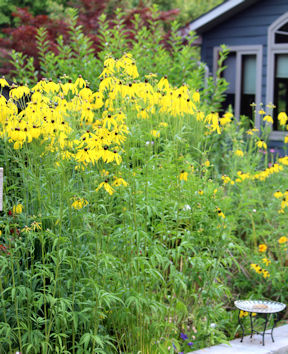 Grey-headed Coneflower is a tall plant with bright yellow, drooping petals and a central cone. This plant is a prolific self-seeder and looks lovely in a large planting. It attracts migrating birds in the fall that fuel up on the seeds.
Perhaps not as valuable as host plants, coneflowers nevertheless are powerhouses as food sources for insects; Grey-Headed Coneflowers thrive in sunny, dry gardens
The Purple Coneflower (Echinacea purpurea), so popular in ornamental gardens, is not native to Ontario but is still a valuable food source.
In all cases, there are many different species in each family of wildflowers encompassing all the varied growing conditions from full sun to full shade, dry, moist, sand, loam, clay and everything in between.
 To achieve the maximum benefits of keystone species in your gardens, choose “straight” natives and avoid cultivars with double blooms and different colours. They have been modified and may not provide pollen and nectar or the altered structure may make it impossible for pollinators to access the food they seek. Check plant lists for your eco-region to learn which keystone species are most appropriate. The free downloadable document can be found at: pollinatorpartnership.ca/en/ecoregional-planting-guides.
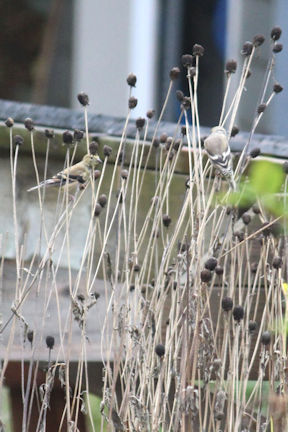
The same stand of Grey-Headed Coneflowers that fueled insects in July and August feeds birds in November
By adding keystone plant species to our gardens, we can greatly increase the diversity of insect life which will, in turn, support birds and other animals. Leaving seed heads and standing stalks through the fall and winter, provides food for wildlife and nesting sites for insects. That gives me hope for tomorrow.
Written ByChristine Roberts is a retired elementary school teacher, past-president of Huron Bruce Nature, executive member of the Ripley and District Horticultural Society, volunteer for the David Suzuki Foundation, VON volunteer fitness leader and a passionate lover of nature.
Related Stories
No related stories.