


 November 11, 2026
130
A while back, I was surprised to learn that Sir Sandford Fleming spent time surveying in Bruce County. It turns out that he cut his teeth in railroading by working on the first rail line in Ontario, which was considering terminating at the mouth of the Saugeen River.
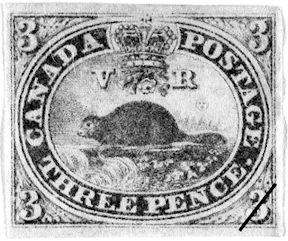 We know Fleming for inventing Standard Time, mapping the route of the Canadian Pacific Railway (CPR), and designing the first postage stamp in 1851 (the Threepenny Beaver). He was knighted by Queen Victoria in 1897.
Sir Sandford Fleming's design for our first stamp, 1851 (right)
Luckily for us, Fleming (1827-1915) kept a diary all his life, starting in Scotland, Jan. 1, 1845. The diary tells how he twice surveyed the Saugeen area in 1853 to see if it was suitable as a railway terminus, incidentally giving us a tiny glimpse of Saugeen (later, Southampton) just five years after its founding by William Kennedy and John Spence.
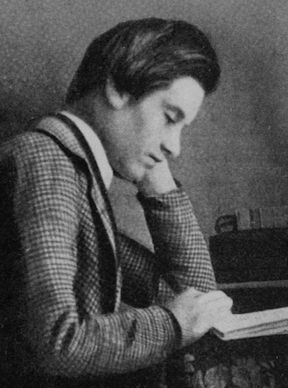
Fleming (left) in 1845, newly arrived in Canada; photo courtesy of the Hutchison House Museum
The first railway in Ontario was the Ontario, Simcoe and Huron Railway (OS&H; later, the Northern Railway). Construction of the OS&H started in Toronto in October, 1851. It would run through Barrie but the question was, should it end on Georgian Bay, or on Lake Huron at Saugeen?
The answer lay in visiting Georgian Bay and Lake Huron and taking soundings of the waters to find a suitable harbour to serve arriving trains. As assistant engineer, Fleming got the job and left Toronto March 22, 1853, taking a stage to Bradford, a horse to Cooksville and a sleigh to Owen Sound.
In his diary for March 27, he wrote, “Country gently rolling and fine timber (beech, maple, rock elm) nearly all the way to Saugeen. Road very rough and beginning to be broken up. … Land in vicinity sandy. Hemlock and cedar but fine country up the river and settling up very fast.”
Then March 28: “Went round the village with the principal inhabitants. Examined river and coast and started for the Sound about 11 o'clock.”
A short visit, then, and he was off to Owen Sound, after staying overnight with Crown Lands Agent Alexander MacNabb.
May 14, 1853, the chief engineer of OS&H ordered Fleming to “make survey of Harbour, Saugeen, Fishing Island and Owen Sound.”
Fleming assembled his survey crew and this time, packed for an extended sojourn. They left Toronto, May 27 aboard the steamer "Ranger," travelling by way of the Welland Canal, Lake Erie and Lake Huron.
 After a detour to Manitoulin, the surveyors arrived at the Fishing Islands. Leaving some men to survey the shore and the islands, Fleming sailed to Saugeen — “Mr. MacNabb and Saugeen people glad to see us”.
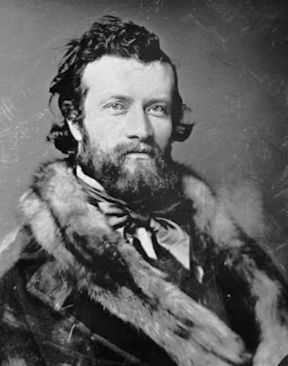
Fleming (right) in the field, surveying for the Ontario, Simcoe and Huron Railway, took him to Saugeen in 1853; photo courtesy of LAC 3507406
They were pleased to see him for good reason. A storm had delayed the party’s arrival and, fearing for their safety, the villagers had chartered a schooner (at a cost of £5) to search for them. The schooner had returned, after a fruitless search, on the very morning that Fleming sailed in. “Very thoughtful,” wrote Fleming. “Stopped at MacNabbs. Got sundry provisions, etc. at Reids.”
By way of thanks for outfitting the rescue schooner, the directors of the OS&H sent £25 to the people of Saugeen, who decided to found a library with the money, to be called the Fleming Library. Fleming was flattered — “a great mark of respect to me surely!” — but the directors politely declined the honour, and the library was not built.
June 12, Fleming rowed back to his camp at Chiefs Point and spent a week placing triangulation stations on the Fishing Islands and sounding the waters.
On a visit to Saugeen he stopped at MacNabbs, bought some supplies and returned to the Fishing Islands. Later in June, Fleming made sketches of some of the Fishing Islands and took a boat upriver as far as Sauble Falls.
They pulled up stakes July 2 and set up a new camp on Chantry Island. Fleming went shopping for provisions in Saugeen and on Sunday, he attended church, had dinner at Mr. MacNabb’s, visited the Indian village, took tea at Mr. Reid’s, returned to church in the evening and, with a storm threatening, stayed at MacNabb’s.
In the following days Fleming ran traverses along the shore, took soundings and walked to the Saugeen bridge with MacNabb and Neil McIntosh.
Fleming spent July 9 at MacNabb’s getting care for the boil on the back of his neck from Mrs. MacNabb and Dr. McIntosh.
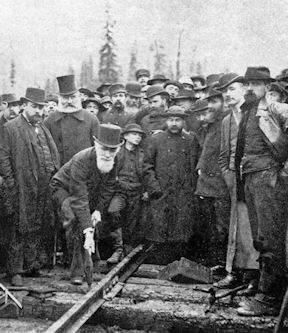
CPR director Donald Smith (left) drives the last spike, 1885; behind him, in the tallest top hat, is Sir Sandford Fleming; photo courtesy of LAC, C-003693
July 16, Fleming went with MacNabb to trace the boundary of his farm. He wrote, “At Mr. Jardin’s to tea. Mrs. Jardin beautiful player on pianoforte, sings well. … Went home to Mr. MacNabbs about eleven.”
July 18, was departure day. Fleming paid £10 in bills owed to Fury (for beef), Belcher, Reid and MacNabb. On his last day in Saugeen, he wrote, “Left with Rev. Mr. Bale and Neil McIntosh from Montreal for Owen Sound. Camped on small island near Main Station Fishing Island.”
He finished sounding Main Station channel and the party rowed on, around Cape Hurd to Cape Croker, where the steamer "Kaloolah" overtook them and towed them to Owen Sound.
During five weeks in Saugeen, from June 11 to July 18, 1853, Fleming’s diary mentions a dozen inhabitants by name. However, he offers no description of buildings or people, apart from Mrs. Jardin’s piano skills.
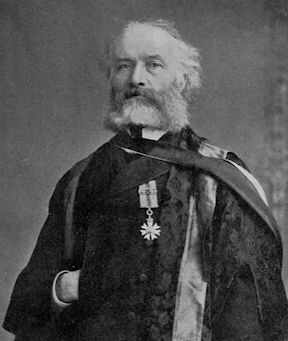 Overall, Fleming’s work for the OS&H Railway was warmly received — the chief engineer praised “the able assistance rendered by Mr. Fleming in the Surveys of the Harbours under consideration, the charts of which, laid down from accurate instrumental Survey, and by laborious Sounding, are of great value.”
Fleming (right) as Chancellor of Queen's University; photo courtesy of Lawrence Burpee
In the end, the OS&H directors chose Collingwood, and the track arrived there in 1855. That same year, Fleming became chief engineer at the OS&H, staying in that position through 1862.
* * *
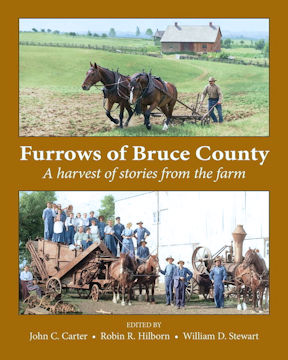
We think you’ll enjoy the Bruce County Historical Society’s latest book, “Furrows of Bruce County: A harvest of stories from the farm” (left). Contact our book sales director, Bill Stewart (willstew@bmts.com). Or visit these fine bookstores: Bruce County Museum in Southampton, Treasure Chest Museum in Paisley, Holst Office Supplies in Walkerton, Bruce County Bookstore in Cargill, Little Blue House Café/Gallery in Tiverton, Hamilton's Toys and More in Kincardine, Treats and Tales in Kincardine, Berford Street Books in Wiarton, Shops at 84 Main in Lion's Head, or Readers' Haven Book Store in Tobermory.
Related Stories
No related stories.