


 October 21, 2016
1954
October 21, 2016
1954

A fellow reporter once told me that journalists have to be experts on a topic for only the length of time it takes to write the story.
And it's true. We research a subject, interview various people, and write the story, including a few delightful photos, and presto ... we're done with that topic and on to the next one.
So it is with electoral reform.
I was invited to Watson Morris' Tuesday morning Grade 10 Civics class, at Kincardine District Secondary School, to hear the students' explanation of possible changes to the electoral system - meaning how Canada votes.
[A non-partrisan committee has been travelling the country, asking people for input about what they don't like about the current First Past The Post (FPTP) system, and how they would change it. The group's recommendations are to be presented Dec. 1.]
I did some quick research, via the Internet, so I could speak on the subject, if asked. But I already knew that the current system is flawed, and only proportional representation, ie. representation by population, is the answer.
Tuesday morning, with camera, notebook and pen in hand, I made my way to Room 19 and settled into a desk, glancing around at the 16-year-olds in the room, and vaguely recalling my high school days some 33 years ago.
Anyway, Mr. Morris (because that's what you call your teacher in high school) outlined the project that the students had embarked upon in their research of electoral reform. They had come up with four proposals: stick with FPTP; switch to Proportional Representation; consider a Preferential Vote; or a mixture of FPTP and Proportional Representation.
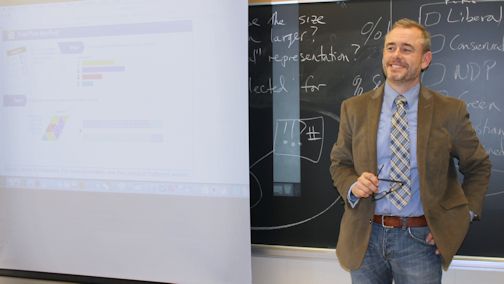
KDSS teacher Watson Morris outlines the project on electoral reform, Tuesday morning in his Grade 10 Civics class
Each group presented its pros and cons.
FPTP is easier, inexpensive, efficient, fast, and the electorate is voting for a local candidate. The flaw in the system is that many voters feel as if their votes don't matter. In the 2014 federal election, the Liberals received only 38.7 per cent of the vote, but managed to get the most seats so they formed the government. In most cases, it's the rural area that feels its voice is not being heard.
Proportional Representation is the most accurate representation of what the voter wants. The party with the highest percentage of the popular vote wins, and other parties get a chance to be in the government. Voters feel as if their votes count. The drawback here, is that people vote for a party, not necessarily a local representative, so they're not sure who will represent their riding in the end.
With the Preferential Vote, smaller parties have a better chance to get seats in the House of Commons. Voters feel as if their votes count, because they choose their first, second and third choices, with the winner selected through a process of elimination. The drawback, is the process is expensive and complicated.
The Mixed FPTP and Proportional Representation would seek the best of both worlds, with two votes cast on one ballot - one for the local candidate and the other for the party. However, this process would also be expensive and complicated.
Okay, explanations over, Mr. Morris and the class looked at me and asked what my preferred process is.
Well, to be honest, I was going with Proportional Representation until you told me that it means I don't vote for a local candidate. Now, all bets are off.
As we argued the point and debated back and forth, I came to the realization that trying to formulate a new voting process is a lot harder than it seems, and a lot more confusing.
Imagine entering the voting booth in the next federal election, and staring at a ballot that has a list of names on it, perhaps four under the Conservatives, three under Liberals, two under the New Democratic Party, and two under the Green Party, and you're to select which candidate you want to win AND which party. But that may or may not be the person to represent your riding.
Principal Mark Ozorio interjected that this is an intriguing project for the Civics students because they will be voting in the next election in 2018.
It's intriguing and confusing, and at the end of the session, we had not come up with an answer.
But there's more discussion to come. The KDSS Civics class is holding a dialogue on electoral reform, Tuesday, Oct. 25, from 7-8:30 p.m., at the KDSS Library, 885 River Lane, Kincardine.
Check it out and learn more. Perhaps there is a Made in Canada solution for this. Or maybe the current process is better than anything else we could devise.
Ah, life in the fast lane!
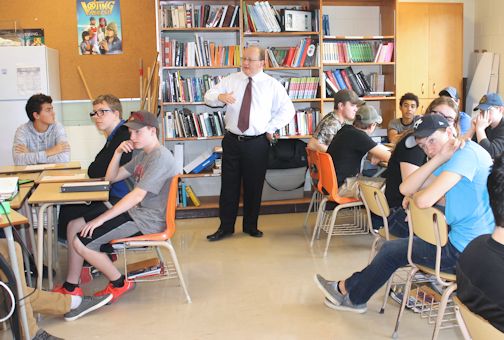
KDSS principal Mark Ozorio (centre) talks to the students in Watson Morris' Civics class, Tuesday morning
Oh, and below, are three essays by students from Mr. Morris' Civics class, outlining the voting processes they favour:
Does our country need to reform its electoral system?
By James Adams
Since the founding of our country, we have voted for a local representative in the House of Commons, known as a Member of Parliament (MP), and by extension, the prime minister. Things have changed over the years to allow more people to be heard. However, it is not enough. This country needs to change its electoral system to Proportional Representation. With Proportional Representation, the people are given more power, the seats in the House of Commons are decided much faster, and the will of the people is represented more accurately.
When we elect a prime minister, everybody gets one vote. But in our current system that one vote counts for a lot less than it should. The country is divided into ridings, and each has a population of about 100,000. We, as individuals, are not being heard enough. Votes for parties other than the Conservatives in this riding, did not matter when the Conservatives won. They got the majority and then that was the election, see you in four years.
That is not right in a democratic society. With Proportional Representation, even if the Conservatives won, your vote would still be counted toward seats in the House of Commons. With this system, individual ridings are not as important. We, as a country, all vote for a party. If that party gets the highest per cent of votes, it becomes the governing party and the leader becomes prime minister.
When an election is held, people vote for a local representative in their riding. There are 338 ridings in Canada and 338 seats in the House of Commons. Whichever candidate wins in your riding gets the seat for your riding.
Look at last year's federal election results: The Liberals won with 184 seats, but received only 39.5 per cent of the actual votes (CBC Election Results, 2015). With Proportional Representation, the Liberals would have received only 135 seats instead of the 184 they won in First Past The Post (National Post, What the Federal Election would have Looked Like with Proportional Representation). They got 39.5 per cent of the votes, so they should get 39.5 per cent of seats not 54 per cent (CBC Election Results, 2015).
There is a huge contradiction in the amount of votes compared to the number of seats. The will of the people was not represented at all there. The majority of the population was against the Liberals. Yet, they won a huge majority in the House of Commons. Is that fair to the people? I don't think so. Do you?
How long does it take do decide election results currently? Far too long. First, they have to count the number of votes a party gets in a given riding. Then those results are submitted to the Chief Electoral Officer. He then finds out how many ridings each party wins and then assigns seats accordingly. In Proportional Representation, it is much faster. You vote, the ballots are gathered and sent to the Chief Electoral Officer and then tallied. Seats are assigned based on a percentage of votes. Even if the party you voted for doesn't win, your vote was still important to the final tally.
To sum up, Proportional Representation must be implemented as the electoral system in our country. It will increase the power of the people, more accurately represent the will of the people, and will be a much more efficient system of voting. This isn’t just your country to vote in, it's your children's too.
First Past The Post should remain as our electoral process
By Jackson Alers
The electoral system Canada has used since 1867 is First Past The Post (FPTP). It is easy to determine a winner. This system has worked well but the people want change. FPTP should stay as our electoral process.
One reason I think we should be using FPTP is because of how easy it is to vote that way. First, you vote for which candidate you would like to represent you, then you vote for whichever prime minister you would like. It’s very simple because all you really do is vote for who you think is going to be the best representative in your area and, really, that’s not very hard. And you look at who has the best views on change, how our education should be run, how our health care should be run, really anything you have similar views on is who you will vote as the prime minister of Canada.
Another reason FPTP is the way we should stay voting is because of how it’s worked for us in the past. Really, if up until now our elections have run without a hitch, why change anything we’ve done up to this point? Some would argue and say change is good but in this case, I think change would be bad. I also assume changing the process now will just confuse older people and lead to fewer votes in the election polls. Also, I think that to change our system, it will take a really long time for it to get organized, and for people to get used to it and know how it works.
FPTP has been Canada’s only way of voting. Canadians are accustomed to voting this way. Canada should stay using FPTP.
Electoral reform needed
By Hannah Gibson-Wilhelm
The Preferential Ballot system (also known as the Alternative Vote or AV) is better for Canada than the others because it distributes the seats to the candidates more fairly. Each party has a more likely chance to get seats or winning the election. The system eliminates the fear of wasting your ballot on a smaller party that might not get to 50 per cent, such as the Green Party, as it takes in your second and third vote. The AV system is able to elect the person who actually had the most support.
First Past The Post (FPTP) allows the candidates with the most votes first to get elected, even if they are not the majority. If the votes were to split between two candidates, say 30 per cent and 30 per cent, and candidate C would get 40 per cent of the remaining vote, then the third party would win even though more people voted for the other two. A real life example would be that in Canada, from 1993 to 2004, the Liberals won a lot of seats and the majority government three times because the Conservative vote had been split between Progressive Conservatives and the Alliance Party.
The AV system makes all votes count and used. When the lowest-voted party is dropped, the second and third choices from the ballots (who had that party for first choice) are taken into account to distribute the votes to the other candidates. This lets people influence the election past their first vote, and lets their choices be heard.
This is important to Canada because FPTP is warped, and slightly unfair in the way things are spread out. The larger parties always get more representation and seats, unlike parties, such as the Green Party and New Democratic Party (NDP). With AV, they have a better shot at getting more seats and, perchance, getting elected. That is why Canada should have a Preferential Ballot system.
Written ByLiz Dadson is the founder and editor of the Kincardine Record and has been in the news business since 1986.
Related Stories
No related stories.