Huron-Bruce MP fields questions at Seniors' Forum in Ripley
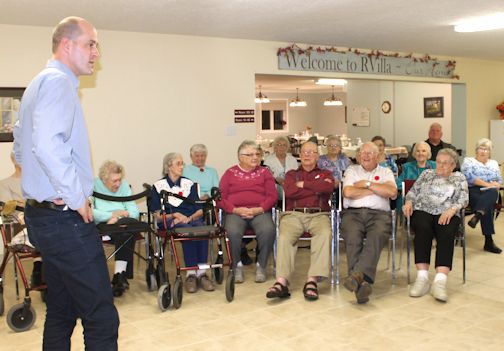
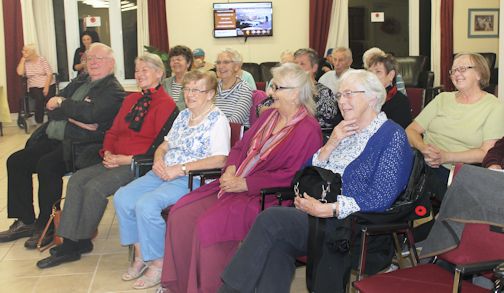
About 50 people attended the Seniors' Forum Tuesday night, at RVilla Retirement Living in Ripley.
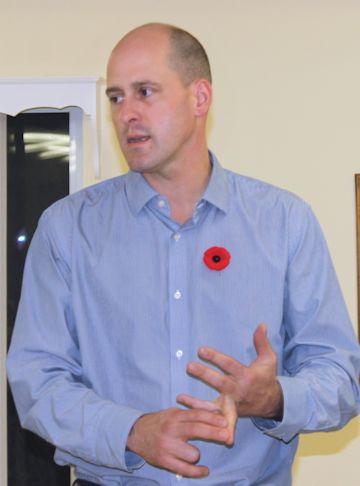
What was supposed to be a discussion about concerns for seniors, with Huron-Bruce MP Ben Lobb and MPP Lisa Thompson, ended up with the federal representative fielding a myriad of questions, in the absence of his provincial counterpart who was unable to attend.
Many of those questions centred on health care and the high cost of electricity, which Lobb said would be better answered by Thompson since they are provincial jurisdictions.
However, he offered some answers from a federal viewpoint.
When asked about health care changes for seniors in the future, Lobb said the main concern is about wait times, particularly in how the Local Health Integration Networks (LHINs) allocate funds for such things as knee replacements.
“If 1,000 people need knee replacements in 2016, they're not all going to get them,” he said, adding that federal funding for health care has increased by six per cent per year since he came to office in 2009.
“But the provinces didn't put six-per-cent more aside for health care. When the health care budget went from $18-billion to $30-billion in seven years, you'd have thought a few new hospitals would be built, but that's not the case.”
He said the Goderich hospital was doing rotator-cuff operations and shoulder replacements and funding them through the hospital fund, thanks to a father-and-son surgical team there. “The number of return visits was a lot less than in London's hospitals, but unfortunately, it didn't last.”
Lobb said the government is going to try and look at doing procedures in rural Ontario where it's cheaper and the patient does not have so far to travel.
Another concern for seniors is their fixed, and dwindling, incomes.
Lobb said a plan is in the works to raise the minimum level for the Guaranteed Income Supplement.
He also told the crowd that often people are unaware that they can fill out a form based on an “unintended separation,” where one spouse is living in a long-term care facility and the other one remains at home. “Financially, you can split off your income from your spouse's income and then, based on the figures, you could both be eligible for the income supplement.”
When asked about the skyrocketing electricity prices in Ontario, and particularly in rural Ontario, Lobb said the “delivery charge” on the hydro bill basically represents 30 years of mismanagement of the transmission system by Hydro One.
He said that he purchased a small property in Point Clark and stayed there a couple of times. When the monthly hydro bill arrived, his consumption charge was $9, but the delivery charge was $99; even the HST charge was more than $9.
While homeowners are upset about the high cost of electricity, businesses and industries are faring much worse, said Lobb, referring to a “global adjustment” on many business bills which is adding thousands of dollars in cost, and causing many business owners to consider shutting their doors.
“You can manage your company as well as possible, and do as much as you can to conserve energy, but you still get stuck with a high hydro bill,” he said.
As for the Green Energy Plan, Lobb said that is the biggest scandal in Ontario.
“The coal-fired plants the government shut down were not the old plants of the 1960s,” he said. “Now, they're burning wood pellets at Nanticoke, which actually increases greenhouse gas emissions, and they're getting the wood pellets from Norway. And they're still burning oil at the Lennox generating plant.”
He said the use of green energy – wind and solar – makes it more difficult to manage the electricity grid, compared to hydroelectric and nuclear plants. “We're lucky we have Bruce Power as our baseload energy generator.”
Lobb said the problem for the federal government in all this, is that it cannot tell Ontario premier Kathleen Wynne what to do.
“It's a flaw in our system that dates back to Confederation,” he said. “Each province is allowed to run its own programs, with no input from the federal government or other provinces. We could have one national transmission system but we won't share our ideas and work together.
“My prediction is that in the new year, we will have a constitutional crisis on health care. Right now, students have an electronic record that follows them wherever they go, but for some reason we can't do that with the health care system because the provinces won't work together to make it happen. They have deemed it to be private information.”
Lobb said there is a staff crisis in health care, but the main reasons are that there is so much paperwork to do; there are younger people being diagnosed with early-onset Alzheimer's and entering nursing homes sooner; and because today's senior population is entering long-term care at an older age.
“The bottom line is funding,” he said. “There are a lot of health care issues where, if the government was pushed to do something, there could be some great results happening.”
 Written By
Liz Dadson is the founder and editor of the Kincardine Record and has been in the news business since 1986.







Related Stories
No related stories.