Kincardine should have natural gas hook-up available by fall of 2018
The $100-million Southern Bruce natural gas project has been delayed, but Kincardine should be connected by the fall of 2018.
That's the word from EPCOR Utilities Inc. representatives and consultant Mark Rodger of Borden Ladner Gervais, who provided an update to Kincardine council in committee-of-the-whole Dec. 20. Similar presentations were made to Huron-Kinloss and Arran-Elderslie councils.
Just over a year ago, the hope was to have natural gas in the three municipalities by late 2016 or early 2017. However, thanks to the requirement of an Ontario Energy Board (OEB) generic hearing, held in the spring, with a decision issued in November, the timeline has been altered by about 18 months.
During the update Dec. 20, Rodger said the OEB decision largely reflects arguments made by the Southern Bruce municipalities and EPCOR, and highlights the importance of ratepayer protection in expansion areas.
He said the OEB encourages competition to protect ratepayers – the risks will be borne by the utility, and there will be stand-alone rates for new customers with no cross-subsidy by existing customers. In addition, the OEB states that the franchise agreement, the Certificate of Public Convenience and Necessity (CPCN) and the Leave to Construct, can all be heard at once.
“We encouraged the OEB to move this project forward,” said Rodger. “Each year, the Southern Bruce project is delayed, adds $25-million to the cost.”
He said the first 90 days of 2017 will be critical. That's when the OEB guidelines will be put in place for application/rate proposals by other utilities, and the provincial government funding criteria will be announced. “After that, we can hold a stakeholder meeting to discuss conversion costs for residents and businesses.”
The province has $230-million in funding available, including $200-million from the Natural Gas Access loan, and $30-million from the Natural Gas Economic Development grant.
Karim Kassam, EPCOR's vice-president of business development, said the route has been revised, with 245 kilometres of natural gas pipeline running from the Dornoch Meter Station, along Bruce County Road 19 and north to Paisley and Chesley; and then continuing along to Bruce County Road 20, the Bruce Energy Centre and Tiverton, along Bruce County Road 23 (B-line) to Kincardine and then south to Lurgan Beach, east along Concession 2 of Huron-Kinloss, north along Bruce County Road 7 to Ripley, east to Holyrood and south to Lucknow.
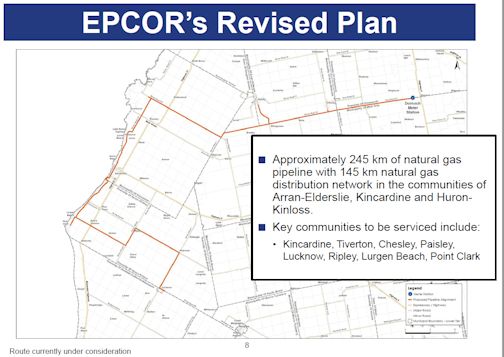
The 145-kilometre natural gas distribution network will serve Kincardine, Tiverton, Chesley, Paisley, Lucknow, Ripley, Lurgan Beach and Point Clark.
Kassam said the route has moved further south in Huron-Kinloss in order to capture the agricultural population in that area.
Once the Environmental Impact Assessment (EIA) is completed in March, 2017, it will be submitted to the OEB, said Kassam. The plan is to hold open houses in early February, 2017, and then kick off the customer conversion campaign in the second quarter of 2017, with storefronts set up in all three communities. This will allow people to take their energy bills in and discuss the cost to convert to natural gas.
Kassam said typical Ontario natural gas rates are about 35 cents/cubic metre. Currently, the lowest cost of heating a house in Southern Bruce is 64 cents/cubic metre, based on propane. The cost is much higher for heating oil and electricity.
“Our target is to be at least 10-15 per cent below the current lowest cost of heating energy,” said Kassam. “In addition to the savings, natural gas will also enhance reliability of supply.”
He said the new schedule calls for the Leave to Construct application to be completed by April, 2017; approvals in place by October, 2017; and then construction begins on Phase 1, which includes Kincardine, Tiverton and the Bruce Energy Centre, to be completed by the fall of 2018. Phase 2 includes Chesley and Paisley, also completed by late 2018; and Phase 3 includes Ripley, Lucknow, Point Clark and Lurgan Beach, to be completed by December, 2020.
Kassam said the typical conversion cost for propane is $700; with anticipated annual savings of $573, the estimated payback period is 1.2 years. The most expensive is electric baseboard hearing with a conversion cost of $11,000; with anticipated annual savings of $2,657, the payback period is 4.1 years.
“Ours is the most active natural gas project, and we hope to get provincial funding in place to help with conversion costs,” said Kassam, adding that the number of residential, commercial and industrial users who commit to converting to natural gas is key to this project's success.
In summary, he said the project will provide a significant boost to the local economy with anticipated savings of $10-million to $20-million annually in residential, commercial and industrial heating bills. The conversion costs will stimulate the local economy to the tune of direct investment of $15-million to $25-million in the first five years.
Access to natural gas will attract new businesses to set up in the Southern Bruce communities, and improve economics and competitiveness of the agricultural sector. It will save a significant amount of annual residential heating costs which is critical for low-income earners, and will attract a young workforce and senior retirees to the area.
Deputy mayor Jacqueline Faubert asked if the OEB's generic hearing decision nullifies the RFP process through which the Southern Bruce communities selected EPCOR and signed a municipal franchise agreement with this company?
Rodger said the OEB is not going to change the municipal franchise regime. However, the franchise can be non-exclusive, meaning the municipalities could give it to more than one utility.
“It's not clear how that is going to work with competing utilities and stand-alone rates,” he said. “EPCOR has already gone through a tough competitive process and been given the franchise.”
He added that if there were a proposal by EPCOR and an alternate utility, and the OEB said the alternate was better, it would be still just a proposal. Until the municipalities select it, it can't be implemented, he said.
“I can't see adding another five years to this project to allow for alternate proposals,” said Faubert. “This is about cost savings.”
“Could we have a monopoly with EPCOR?” asked councillor Maureen Couture.
“If the municipalities went only with EPCOR, yes,” said Rodger. “But you have to have the franchise before you can implement it.”
“If we don't go with the OEB's suggestion, does that mean we don't get the government funding?” asked councillor Randy Roppel.
“That's a possibility,” said Rodger, “but there are no funding guidelines in place yet. The OEB knows the process we've gone through to choose EPCOR.”
He said in the OEB's proposed competitive framework, there will be a fine line between transparency and confidentiality.
“No company is going to put in a bid and let other companies see it,” said Hanan Campbell, associate general counsel for EPCOR. “It's going to be a challenge for the OEB to produce a framework that allows for this competitive process.”
“We produced a price,” said Kassam, “and then Union Gas came up with a lower price for the generic hearing.”
“So much of this project depends on the provincial guidelines that are to come out early next year,” said mayor Anne Eadie.
The public portion completed, the meeting moved into closed session for discussion of advice subject to solicitor-client privilege.
 Written By
Liz Dadson is the founder and editor of the Kincardine Record and has been in the news business since 1986.




Related Stories
No related stories.