University of Guelph, Bruce Power, Nordion team up for research project using Cobalt-60
A high-tech form of insect birth control connected to nuclear power, could solve a devastating pest problem for Ontario farmers, says a University of Guelph researcher.
Officials at Bruce Power, the world’s largest operating nuclear facility located in the Municipality of Kincardine; and Nordion, a global health science company that provides market-leading products used for the prevention, diagnosis and treatment of disease; announced Thursday they are providing funding and support for a multi-year study, led by professor Cynthia Scott-Dupree, on sterilizing pepper weevils using Cobalt-60.
The researchers hope to control pepper weevils, which can burrow into farmed peppers and destroy them from the inside.
“It is very difficult to control these insects when they are hidden inside the pepper,” said Scott-Dupree.
According to the Ontario Greenhouse Vegetable Growers, pepper weevils ruined $83-million worth of crops in 2016 – a figure that does not include the costs of management, suppression initiatives or clean-up of the pest.
Cobalt-60, which is produced in four of Bruce Power’s eight nuclear reactors, is used for the Sterile Insect Technique (SIT), which could be a powerful strategy for controlling the weevil, said Scott-Dupree, of the university's School of Environmental Sciences.
“We want to move away from insecticide as much as possible, and SIT provides us another tool in our pest-management toolbox,” she said. “It fits well with biological-control programs that growers already have established in their greenhouses. While no strategy is 100-per-cent effective, using nuclear energy to sterilize insects is an environmentally-friendly method of controlling these pests. There is no danger of the pepper weevils spreading any radiation following sterilization, so it is also safe for people.”
Scott-Dupree, the Bayer CropScience chairperson in sustainable pest management at the university, will send pepper weevils to Nordion, an Ottawa-based supplier of medical isotopes and gamma technologies, which receives its Cobalt-60 from Bruce Power. Gamma radiation from Cobalt-60 will sterilize the insects before they are released to mate with normal, unsterilized pepper weevils in greenhouses.
“We will only release pepper weevils that have all the attributes of normal, unsterilized weevils, except that they are sterile,” said Scott-Dupree. “When they mate, the eggs will not be viable, no progeny results and the pest population will decrease.”
Families and businesses in Ontario rely on low-cost nuclear for 60 per cent of their electricity each year, said Ontario energy minister Glenn Thibeault who visited Nordion lab facilities in Ottawa, Thursday. Ontario's Long-Term Energy Plan recognizes the far-reaching benefits of nuclear energy, whether through low-cost, carbon-free power; jobs; economic benefit; clean air; health care; or as is the case with this collaboration, agriculture.
“It is exciting to see Ontario’s nuclear community joining forces to help researchers discover innovative, environmentally-friendly ways to deal with agricultural pests that cause real harm to food crops,” said Thibeault. “This partnership again demonstrates that Ontario’s nuclear industry is a global leader, providing wide-ranging economic benefits, jobs, and scientific advancement.”
Pioneered in the 1950s, SIT has been successfully used to control the codling moth, a pest of apples, in the Okanagan Valley in British Columbia since 1992. Scott-Dupree has also recently conducted research which has found that SIT has the potential to control American serpentine leafminer, an insect pest that feeds primarily on chrysanthemums.
Cobalt-60 harvested from Bruce Power’s reactors, is already used to help sterilize 40 per cent of the world’s single-use medical devices and treat brain tumours.
“This innovative research could improve Ontario’s agricultural sector by reducing the impact of pests on produce, while also providing a possible gateway to the future of farming,” said Mike Rencheck, Bruce Power’s president and chief executive officer.
Scott-Dupree and her team plan to determine the optimum radiation dosage that ensures the sterilization of pepper weevils before testing SIT releases in greenhouses.
“The study will take some time but the potential it has, makes it worthwhile,” she said. “It is exciting to think of all the benefits this study could mean for farmers, Ontario’s economy and the environment.”
Nordion’s facilities will be used to sterilize the pepper weevils.
“We are excited to see a technology like SIT, which has had wide and successful application in other areas of the world, help us here in Ontario,” said Ian Downie, vice-president of Gamma Technologies at Nordion. “Our partnership with Bruce Power helps us support these kinds of scientific advances using Cobalt-60.”
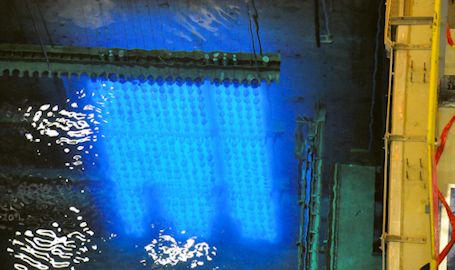
 Cobalt-60 is an isotope that emits gamma rays essential to the medical community for cancer treatments and the sterilization of medical devices, while it also helps to prevent the spread of disease through an innovative insect-sterilization technique; Cobalt-60 emits a blue glow called the 'Cherenkov effect' when removed from a nuclear reactor and placed in water, which protects the surface from its radioactivity; the Cobalt rods spend up to two years in Bruce Power's nuclear reactors before being shipped to Nordion in Ottawa, where they are processed and shipped worldwide for various uses; photo courtesy of Bruce Power
 Written By
No bio for this author.





Related Stories
No related stories.