Kincardine Residents Against Phragmites continue battle, with help from Bruce Power
The Kincardine Residents Against Phragmites continue their battle to save the Lake Huron shoreline from the invasive species, Phragmites Australis, and are thrilled to have the support of Bruce Power.
The group's president, Gail Walden, said Bruce Power has provided $5,000 per year for three years to assist the residents in their work to control phragmites.
“We are very grateful to Bruce Power for its insight and support on this project," said Walden. "We are fortunate to have a company in our area that is completely dedicated to the environment and to protecting the shoreline and beyond.”
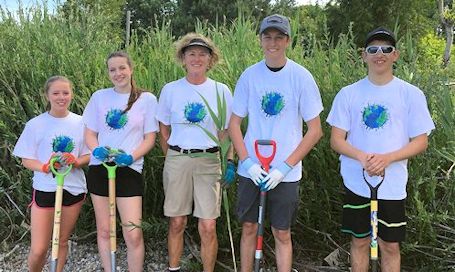
The group used the funds to purchase tools and to hire summer students to rake up dead phragmites (phrag) and to spade plants that are re-growing. Spading involves using a shovel to cut the plant off under the surface of the ground at the root level.
The students have been working on the shore along an eight-kilometre stretch from Goderich Street, in the southern most part of the Municipality of Kincardine, to north of Concession 5. They are amazed at how much phragmites they are seeing in Kincardine.
"I went to the beach with my friend the other day and I kept seeing phrag," said Belle Wilson.
The students are wearing “Phrag Buster” T-shirts, featuring artwork from Huron Heights Public School Grade 7 student, Harleen Randhawa. People who see the students working, are welcome to ask questions or pick up a shovel and help out if they like!
The group's secretary, Marlene Morrow, a retired teacher who returns to local schools as an occasional teacher, said the additional support of hired students is very encouraging.
"A few dedicated volunteers have been fighting this extremely-invasive and fast-growing species for years and although success is evident, there is still much to do," she said. "As well, having youth educated about phragmites brings hope that eventually it can be eradicated."
Invasive Phragmites creates tall, dense stands of grass which degrade coastal areas and wetlands by crowding out native plants and animals, blocking shoreline views, reducing access for swimming, fishing and hunting and, in addition, can create fire hazards from the build up of dry plant material. Phragmites typically grows on coastal beaches and wetlands, roadside ditches and other low, wet areas, although occasionally, it has been found to grow in dry areas.
Phragmites typically colonizes a new area from seeds or small fragments of rhizomes (underground stems), dispersed by water, animals, machinery and humans. Once established, new stems grow from the underground rhizomes and the plant begins to spread. During the growing season, rhizomes spread horizontally in all directions and when fragmented, readily develop into new plants.
Phragmites has been a problem in the Kincardine area for the past several years. The Municipality of Kincardine first dealt with the issue in 2013 and has, so far, spent $100,000, with more budgeted for 2017, in an effort to eradicate the weed.
In the fall, Kincardine’s phragmites was sprayed. This made a significant impact on the areas where the phragmites had taken over.
Dr. Janice Gilbert, a wetland ecologist and a phragmites advisor for Kincardine, said she can see great improvement along Kincardine’s shoreline where herbicide application has been able to take place. Although the higher lake level has helped to “drown” some phrag, the higher level has also created a problem for spraying the weed as the herbicide cannot be applied to plants that stand in water.
“This has hampered our ability to effectively deal with phragmites in the winter,” said Gilbert. “This year, the municipality will be partnering with the Invasive Phragmites Control Centre to undertake a cutting program to drown or stress the plants along certain sections of the shoreline.” She added that a specialized crew will also spot spray phragmites, where feasible, on dry sites.
This year, the plants are re-sprouting and steps are being taken to stop the spread of the weed.
The problem has spread beyond the shores of Kincardine. Phrag has been spotted in ditches throughout Kincardine and in residential backyards.
“Education of our community is key to our eventual success in eradicating this invasive weed, so I would encourage people to attend an upcoming free lunch-and-learn event,” said Anita Heikkila, vice-president of the Kincardine Residents Against Phragmites.
The event will take place Saturday, July 22, from 11:30 a.m. to 1 p.m. at the Brucedale Conservation Area, and is sponsored by the Lake Huron Centre for Coastal Conservation, Saugeen Valley Conservation and Enbridge Green Energy.
Phragmites is not only damaging the shorelines, but is thick in ditches along highways and secondary roads. These act as conduits for its rapid and unmitigated spread to the shorelines.
People who can identify the weed are needed to walk along the beach and contact any member of the group so that it can be removed immediately. Since phragmites can spread over 10 feet per year, early intervention is paramount.
“People need to understand the delicate nature of our beaches and dunes, and to stay off them with all ATVs, boats, trailers, and construction equipment, as these spread seeds and/or plant parts,” said Heikkila.
If residents or property owners spot phragmites, or if they are interested in volunteering with the Kincardine Residents Against Phragmites, contact Walden at michaelgailwalden@gmail.com or Morrow at marlenemorrow14@gmail.com
Provincially, the Ministry of Transportation Ontario (MTO) has taken the initiative in the southwest region to control and stop the spread of phragmites. Control measures are being taken along the Highway 401 corridor from Windsor to London as well as along Highway 402 from Sarnia to London.
Here in Kincardine, the municipality is determined that the problem be addressed before it becomes too difficult to easily manage.
Kincardine recreation director Karen Kieffer said the municipality is committed to the elimination of phragmites. "With the support and co-operation of concerned residents, phragmites experts and companies such as Bruce Power, we are confident we will see the eradication of this weed."
 Written By
Liz Dadson is the founder and editor of the Kincardine Record and has been in the news business since 1986.




Related Stories
No related stories.