Retired American astronaut helps launch Nuclear Innovation Institute
The official launch of the Nuclear Innovation Institute received an added boost, thanks to a riveting message by retired American astronaut and author Mike Mullane.
Held Tuesday at the Bruce Power site in the Municipality of Kincardine, the event welcomed several dignitaries and founding members of the institute.
Bruce Power president and chief executive officer Mike Rencheck said the launch marks the beginning of something that was begun last May with the announcement of the institute to be located in Saugeen Shores.
“As we look to 2064, we can work together with our suppliers, with universities and with our communities to do things we couldn’t even imagine,” he said. “We're providing access to technologies that are usually found only in big cities.”
Holding up a box of medical equipment, he said the items have a connection to this small rural location in Ontario. “Bruce Power provides medical isotopes to sterilize 40 per cent of the one-time-use medical equipment used in the world.”
With the Nuclear Innovation Institute, “what we can imagine, can become possible,” he said. “When you look toward 2064, what do you see? How can you help us get there, as a community, an industry and as Bruce Power?”
In introducing Mullane, James Scongack, executive vice-president of corporate affairs and environment at Bruce Power, noted that the people in the 1960s and '70s did all the heavy lifting to bring the nuclear industry to the Bruce site.
Holding up a “Hamilton Spectator” newspaper from 50 years ago, he showed the banner headline about the Apollo mission that landed on the moon, and said Mullane was part of that space race.
“What are we doing today to set us up for success in the next 50 years?”
Mullane spoke mainly about teamwork as he addressed the audience, focusing on his life as an astronaut.
He said the two emotions that an astronaut feels as he is strapped into that rocket or shuttle, are fear and joy. There's the gut-wrenching fear of heading out into space, but also the joy as your lifetime quest is to travel in space.
“If you're blasting into space, what you want is a world-class team behind you,” he said, adding that NASA (the National Aeronautics and Space Administration) in the United States was world class until it ran into problems which led to the “Challenger” shuttle disaster in 1986.
The four things to remember, said Mullane, are:
- Failure is not an option
- Guard against normalizing deviance
- One person with courage can form a majority
- Continue self-improvement
With regard to failure, he said when an astronaut gets into that shuttle, he fears for his life, and is taking a huge risk. The NASA team must have his back, so failure is not an option.
As to normalizing deviance, Mullane said that stems from short-cutting normal best practices, which NASA ended up doing, under pressure to maintain a minimum number of flights.
“The Challenger disaster was a predictable surprise,” he said. “Engineers knew there was a problem with the 'O' rings up to four years before because they were burned on other rocket boosters. In 1986, two 'O' rings failed and the booster blew up, killing seven astronauts.”
He said the best practice should have been to suspend flights once the engineers realized that the 'O' rings were being touched by fire, which they were never designed to do.
However, it came down to costs and cut-backs, amid the space race, he said. “There was a warning from the engineers in their risk assessment, drawing a direct link from the damage to the 'O' rings to the possibility of a lost crew and launch pad facilities. Unfortunately, with the number of successful flights, the risk was reduced.”
The lessons learned from the Challenge disaster were:
- Don't rest on your laurels – a world-class performance legacy will not protect you - there were only 13 years between the final Apollo mission and the Challenger disaster
- Follow procedures
- Risk has no memory
- Best practice deviance can light a fuse to future risks
- Communicate bad news to leadership
- Set challenging, but attainable, goals
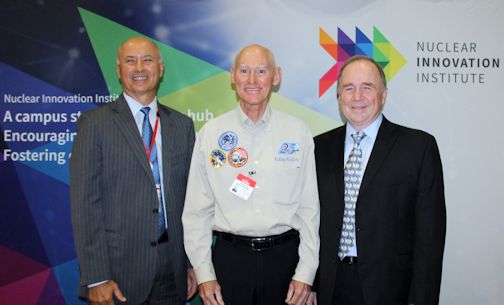 Guest speaker Mike Mullane (centre) stands with Bruce Power president and CEO Mike Rencheck (left) and Nuclear Innovation Institute president Frank Saunders at the official launch of the institute, Tuesday
With regard to having courage, Mullane said everyone on the team counts. “If you see something, say something and do something. Leaders, empower your teams.”
He said the space shuttle had no crew escape system. The experts could come up with nothing that worked. It was a flight surgeon who developed a slide-pole system that was used as an escape mechanism.
And finally, regarding continuous self-improvement, Mullane outlined his own life as a teenager passionate about becoming an astronaut.
“My energy was narrowly-focused on aviation and rocketry,” he said, “and I had an abundance of tenacity and a passion for goal-setting.”
He graduated from West Point and served with the United States Air Force in Vietnam. He went on to earn a Masters degree in aero-engineering and in 1978, he became an astronaut.
His lessons:
- You don't have to be extraordinary to achieve extraordinary results.
- Dream big – don't be timid in setting goals
- Do your best – everything we do counts
- Genius is over-rated – tenacity counts BIG
- Don't be afraid of failure
- Envision mission success
So, how did NASA fix the 'O' ring problem in the shuttle? By adding a third 'O' ring, said Mullane.
He said the American space program has been privatized which brought a huge negative reaction from 25 NASA legends in a letter to president Barack Obama in 2010.
However, he said, that program is close to launching humans into space again after about eight to nine years, faster than would have been done under the previous NASA administration.
“There is now a Falcon X heavy rocket that can carry twice the weight at one-third the price,” said Mullane. “Change is scary and it can be difficult, but it is a necessary part of achieving success, so embrace it!”
“This is the type of educational support that can be offered by the Nuclear Innovation Institute,” said Rencheck, after thanking Mullane for his tremendous presentation. “These are our aspirations for the future.”
Mullane, who completed 134 combat missions in Vietnam while in the Air Force and later flew three missions into outer space with NASA, signed copies of his book, “Riding Rockets.”
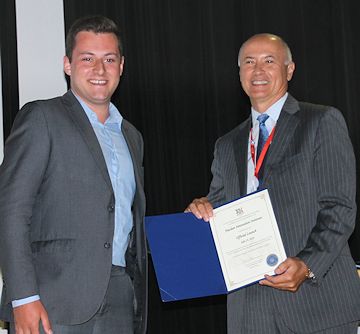
Bruce Power president and CEO Mike Rencheck (right) accepts a certificate of congratulations from Steve Travale, representing Huron-Bruce MPP Lisa Thompson
Others offering congratulations at the launch, were Huron-Bruce MP Ben Lobb, Steven Travale representing Huron-Bruce MPP Lisa Thompson, and Bruce County warden Mitch Twolan.
The institute is temporarily located in a Port Elgin office building, but is slated to move to the Saugeen Shores Police building once the new police station is built.
Also, it was announced that Kinectrics is the first Bruce Power supplier to indicate its intent to join the institute's Founding Members Club, becoming part of Canada’s leading-edge nuclear applied research facility and centre of excellence for talent development and business innovation.
“After such a successful year in getting things up and running,” said institute president Frank Saunders, “we are ready to turn our attention to securing members and demonstrating the benefits we will bring to our members, our stakeholders, and our communities across Bruce, Grey, and Huron counties and beyond.”
And finally, Saunders announced the institute's Founding Member Board which includes Rencheck as chairman, Twolan as vice-chairman, Scongack, Saunders, Jim Phillips as Good Governance member (sponsored by Bruce Power), Jessica Linthorne (Saugeen Shores ex-officio member) and its newest member, David Harris (Kinectrics).
The institute is now officially open for business – with the launch of its new website –
www.nuclearinnovationinstitute.ca and membership details.
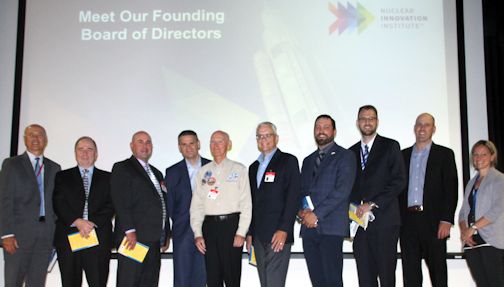 Celebrating the launch of the Nuclear Innovation Institute, Tuesday at the Bruce Power site, are Bruce Power president and CEO Mike Rencheck (left), institute president Frank Saunders, Bruce County warden Mitch Twolan, James Scongack of Bruce Power; guest speaker Mike Mullane, institute board member Jim Philips, Saugeen Shores mayor Luke Charbonneau, Kinectrics director of innovation Sean Donnelly, Huron-Bruce MP Ben Lobb, and Stellina Williams, executive director of the Nuclear Innovation Institute
 Written By
Liz Dadson is the founder and editor of the Kincardine Record and has been in the news business since 1986.



Related Stories
No related stories.