Huron-Kinloss still potential host for used-nuclear-fuel DGR
Huron-Kinloss Township continues to be a potential host area for the proposed Deep Geological Repository (DGR) for the long-term management of used nuclear fuel.
Tuesday, officials with the Nuclear Waste Management Organization (NWMO) announced the company is advancing the site-selection process and narrowing the focus to two potential siting areas, from five.
The Township of Ignace in northwestern Ontario, and the Township of Huron-Kinloss and Municipality of South Bruce in southern Ontario, will continue to be considered potential host areas for the project.
In Huron-Kinloss and South Bruce, one of these communities will move forward in the site-selection process once a potential repository site is located in the area through an ongoing process with local landowners.
The areas around the Townships of Hornepayne and Manitouwadge in northern Ontario will no longer be considered.
“As we work toward identifying a single, preferred location for this project, in an area with informed and willing hosts, we need to increasingly focus on specific locations that have strong potential to meet the project’s safety and partnership requirements,” said
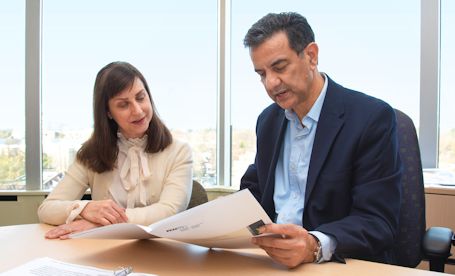
Dr. Mahrez Ben Belfadhel, vice-president of site selection at the NWMO (above right, with Deena Waisberg of the stakeholder relations team).
“These are hard decisions and not made lightly, but ultimately, we are working toward identifying one area where we can implement Canada’s plan to ensure the protection of people and the environment.”
The site-selection process has been under way since 2010, and a decision is expected by 2023.
The process began with 22 municipalities and indigenous communities that expressed interest in learning more and exploring their potential to host the project. The NWMO has gradually narrowed its focus to fewer areas through technical site evaluations and social engagement to assess safety and the potential to build supportive and resilient partnerships, key criteria to assess the suitability of each area.
In the remaining areas, next steps will include working with municipal and indigenous communities to conduct progressively more-detailed technical site evaluations and social studies. This work will further assess safety and explore how the project can be implemented in a manner that will enhance the well-being of municipal and indigenous communities in each area.
“At the NWMO, we stand on the shoulders of giants,” said Belfadhel. “I want to thank the leaders and people of the many communities that have been so actively engaged in this process. This project is moving forward according to plan, and their forward-looking leadership and contributions to Canada’s plan are helping solve a challenge on behalf of all of us, for generations to come.”
The municipalities and indigenous communities exiting the site-selection process, as well as their neighbouring communities, will be eligible for one-time community well-being investments to acknowledge their leadership and role in contributing to Canada’s plan. These investments will be made in a community well-being reserve fund (or equivalent) and are a way for the NWMO to continue contributing to well-being, even as work continues in other areas.
 Written By
No bio for this author.



Related Stories
No related stories.